Concrete Curbing and Edging Solutions for Beautiful Landscaping
Concrete Curbing and Edging Solutions for Beautiful Landscaping
Reading time: 14 minutes
Picture this: You’ve just spent thousands of dollars on lush sod, ornamental shrubs, and carefully arranged flower beds. Six months later, grass is creeping into your mulch, gravel is scattered across your driveway, and the clean lines you imagined are a distant memory. Sound familiar? You’re not alone — and the fix is simpler than you think.
Concrete curbing and edging is one of the most underrated landscaping investments homeowners and commercial property managers can make. It’s not just about aesthetics. It’s about long-term structural integrity, reduced maintenance time, and the kind of curb appeal that genuinely increases property value. In 2026, with landscaping budgets rebounding strongly after years of supply-chain disruptions, more homeowners are turning to durable, permanent edging solutions over temporary plastic alternatives.
This guide walks you through everything you need to know — from material options and installation techniques to real costs and design inspiration — so you can make a confident, informed decision for your outdoor space.
Table of Contents
- Why Concrete Edging Actually Matters
- Types of Concrete Curbing and Edging
- Comparing Your Options: A Practical Breakdown
- Installation: DIY vs. Professional
- Design Trends in 2026
- Common Challenges and How to Overcome Them
- Cost Expectations and ROI
- Frequently Asked Questions
- Your Landscaping Transformation: Next Steps
Why Concrete Edging Actually Matters
Let’s get one thing straight: concrete curbing isn’t just decorative trim. It’s a functional boundary system that defines zones, controls soil migration, manages water runoff, and reduces the time you spend on weekend maintenance. According to the National Association of Landscape Professionals (NALP), homeowners who invest in permanent edging solutions report spending up to 40% less time on lawn maintenance annually compared to those using temporary or no edging.
In 2026, the landscaping industry in the U.S. is valued at approximately $176 billion, with hardscaping — including concrete elements — representing one of the fastest-growing segments. That growth reflects a broader cultural shift: homeowners want outdoor spaces that are beautiful AND low-maintenance. Concrete edging sits at that exact intersection.
Beyond time savings, well-installed concrete curbing can increase your home’s perceived value. A 2025 study by the American Society of Landscape Architects (ASLA) found that professionally landscaped properties with defined edging systems commanded an average premium of 5.5% to 12% over comparable homes without them. That’s not a small number when you’re talking about median home prices in today’s market.
“Concrete edging is the backbone of a well-maintained landscape. Without it, even the most carefully designed garden will lose its structure within a season.” — Marcus Rivera, Certified Landscape Architect, Rivera Design Group (2025)
Types of Concrete Curbing and Edging
Extruded Concrete Curbing
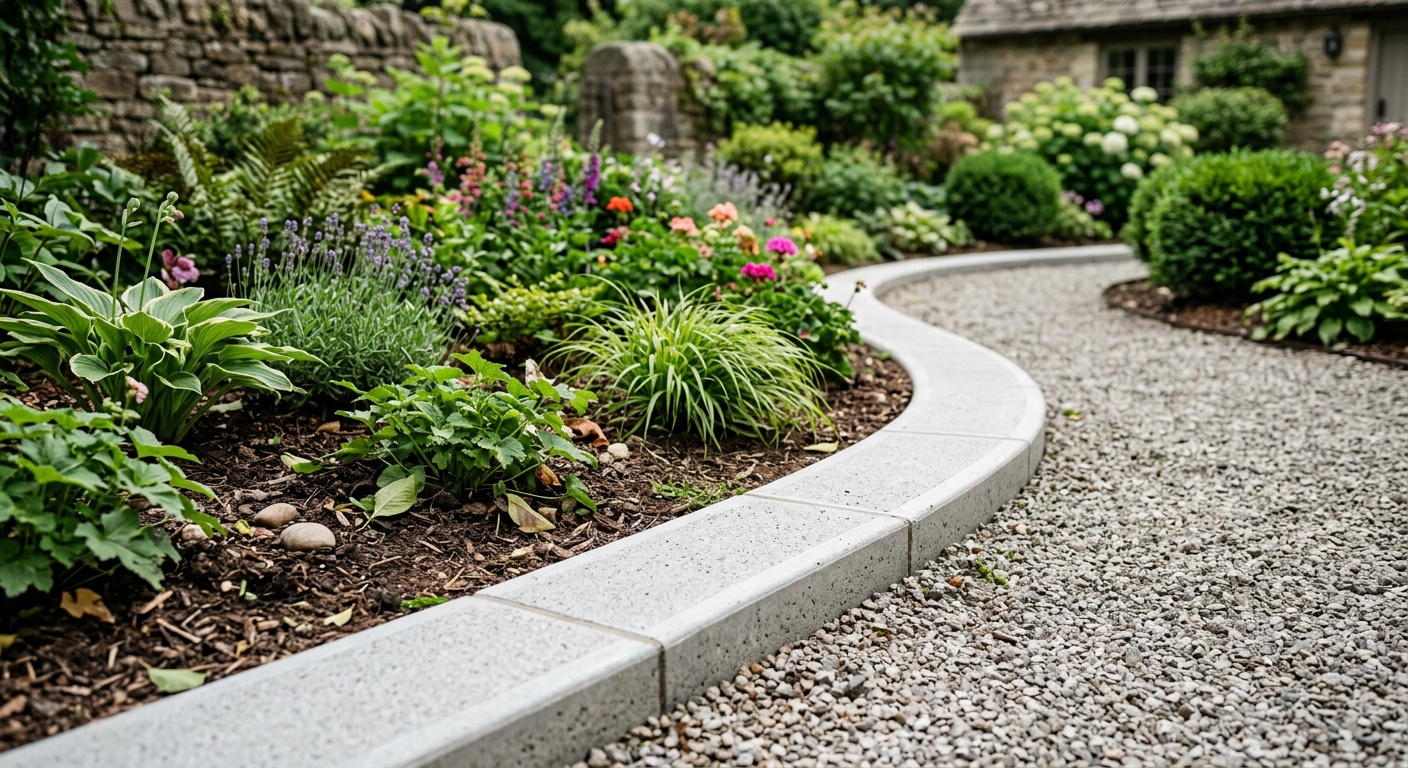
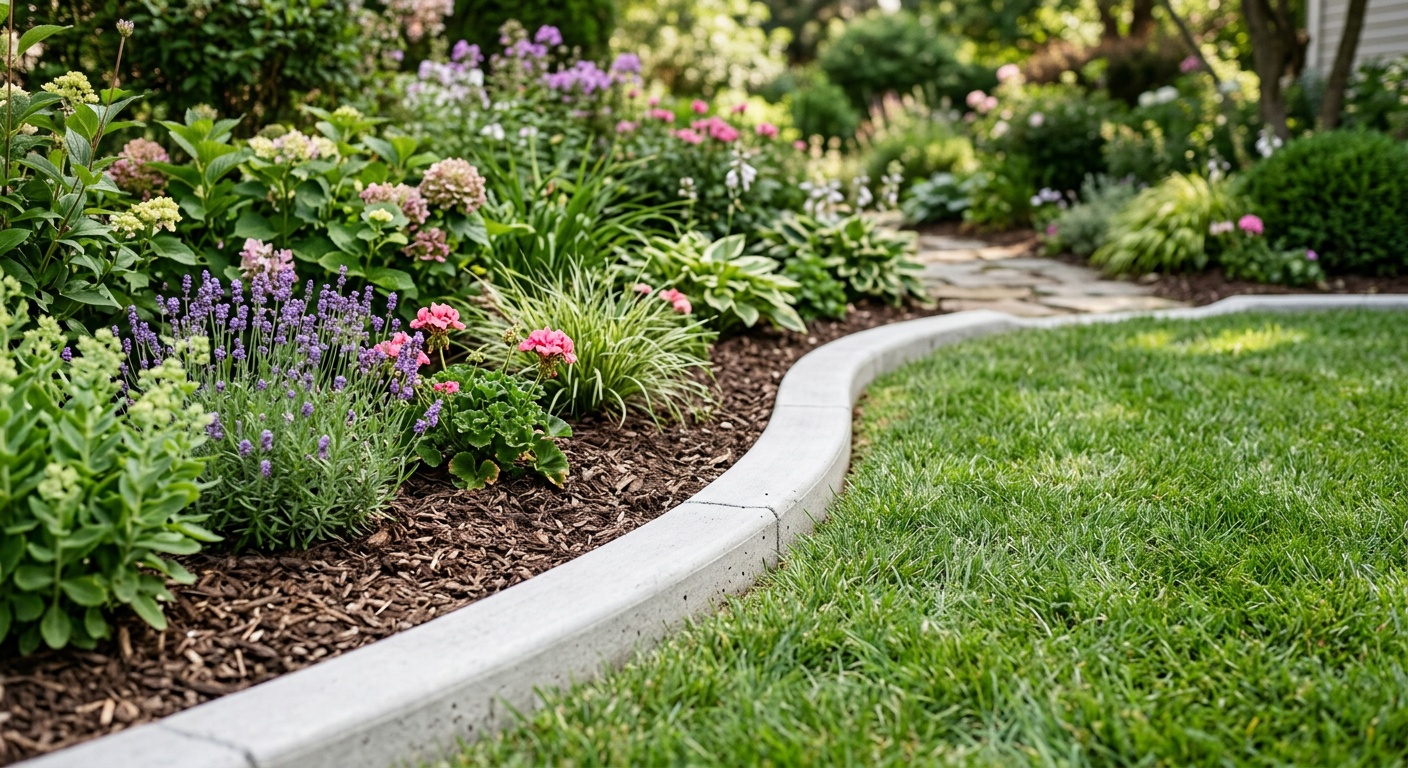
Extruded concrete curbing is the gold standard for residential landscaping. Using a specialized curbing machine, a continuous ribbon of concrete is shaped and laid directly onto prepared soil. The result is a seamless, professional-looking border that requires no joints — meaning fewer points of failure and a cleaner visual finish.
This method is ideal for curved garden beds, driveway borders, and decorative pathways. You can choose from several profile shapes including:
- Mower’s edge: A low-profile, flat-topped curb designed so lawn mowers can ride directly over it, eliminating the need for string trimming along the border.
- Slant edge: A simple angled profile, great for flower beds and mulched areas.
- Scallop or decorative profiles: Curved, ornamental shapes that add a traditional garden aesthetic.
- Barrier curb: A taller, more structural profile used to contain gravel, prevent vehicle encroachment, or manage drainage flow.
Color pigments and surface stamps can be added to match your home’s exterior, giving extruded curbing a truly custom look.
Poured-in-Place Concrete Edging
Poured-in-place concrete is exactly what it sounds like: concrete mixed and poured into a custom form built on-site. This method offers maximum flexibility in terms of width, height, and shape. It’s commonly used for:
- Wide decorative borders adjacent to driveways or sidewalks
- Retaining mini-walls between tiered garden beds
- Custom shapes that extruding machines can’t replicate
- High-traffic commercial edging applications
The downside? It’s more labor-intensive and typically more expensive. However, poured-in-place concrete offers superior structural strength — critical in climates with heavy freeze-thaw cycles.
Precast Concrete Edging Blocks
Precast blocks are manufactured off-site and installed by laying them end-to-end in a prepared trench. They come in standard sizes and shapes — most commonly rectangular or scalloped — and are widely available at home improvement stores. They’re the most accessible DIY option, but they come with trade-offs: visible joints, potential shifting over time, and a less seamless appearance compared to extruded options.
That said, for small garden projects or budget-conscious homeowners, precast blocks are a perfectly respectable choice. They’ve improved considerably in quality over the past few years, with many manufacturers now offering interlocking designs that reduce movement and separation.
Comparing Your Options: A Practical Breakdown
Not all edging solutions are created equal. Here’s a side-by-side comparison to help you cut through the noise:
| Feature | Extruded Concrete | Poured-in-Place | Precast Blocks | Plastic Edging |
|---|---|---|---|---|
| Durability | 20–30+ years | 25–40+ years | 10–20 years | 3–7 years |
| Avg. Cost (per linear ft) | $4–$9 | $7–$15 | $2–$6 | $0.50–$2 |
| Maintenance Required | Very Low | Very Low | Low–Medium | Medium–High |
| DIY Friendly | No (requires machine) | Intermediate | Yes | Yes |
| Aesthetic Quality | Excellent | Excellent | Good | Fair |
The data is clear: if you’re making a long-term investment in your property, extruded or poured-in-place concrete dramatically outperforms plastic alternatives. The upfront cost difference is easily offset within 5–7 years when you factor in replacement and maintenance costs for lower-quality options.
Installation: DIY vs. Professional
Going the DIY Route with Precast Blocks
If your project is modest — say, a small flower bed or a garden pathway border under 50 linear feet — a DIY approach with precast blocks is entirely achievable. Here’s a practical step-by-step framework:
- Mark your layout: Use landscaping paint or a garden hose to define the edge line before you dig. Take your time — this step determines everything else.
- Excavate a trench: Dig 4–6 inches deep and slightly wider than your block profile. Flat and level matters more than deep.
- Add a gravel base: A 1-inch layer of compacted gravel improves drainage and reduces frost heave in colder climates.
- Set your blocks: Place them firmly, checking for level as you go. Use a rubber mallet to seat each block.
- Backfill and compact: Fill both sides of the edging with soil and tamp firmly. This locks the blocks in place.
Pro Tip: Rent a plate compactor from your local equipment rental company for the final step — it makes a significant difference in long-term stability and costs only about $60–$90 per day.
Why Professional Installation Pays Off
For extruded concrete curbing, professional installation isn’t just recommended — it’s essential. The specialized extrusion machines cost between $15,000 and $40,000, which makes DIY ownership impractical for most homeowners. But beyond equipment, professional installers bring critical expertise in:
- Soil preparation and grading to prevent settling
- Concrete mix ratios appropriate for your local climate
- Control joint placement to manage cracking
- Color matching and decorative stamping
- Proper curing procedures for maximum strength
Real Example — The Hendersons, Phoenix, AZ (2025): The Henderson family hired a professional curbing contractor to edge approximately 380 linear feet of garden beds around their newly built home. The project — extruded concrete in a mower’s edge profile, terra cotta color, with a light broom finish — was completed in a single day for $2,850. Their landscaper estimated they’d previously been spending 3–4 hours per month re-edging beds manually. At that rate, the curbing paid for itself in saved labor within 3 years, and added an estimated $8,000 to their home’s appraised value at their 2026 refinance.
Design Trends in 2026
Concrete curbing isn’t just about function anymore. In 2026, the design conversation around landscaping edging has evolved significantly, influenced by broader trends in sustainable design, biophilic aesthetics, and smart outdoor living spaces.
Here are the dominant design directions shaping the industry this year:
- Earth-tone color palettes: Warm terracotta, sandstone, charcoal, and sage green pigments are replacing the stark gray of traditional concrete. These colors harmonize with natural stone and wood elements increasingly popular in contemporary landscaping.
- Organic curves over straight lines: Sweeping, organic curves are in. Rigid, rectangular borders feel dated. Extruded concrete’s ability to follow any curve makes it perfectly suited to this trend.
- Integrated drainage channels: A growing number of homeowners are requesting curbing designs that incorporate subtle drainage channels — functional solutions disguised as decorative features.
- Textured and stamped surfaces: Cobblestone, wood grain, and slate-impression stamps on concrete curbing give the look of premium materials at a fraction of the cost.
- Contrast edging: Using lighter concrete borders against dark mulch or gravel — or vice versa — to create bold visual definition in modern landscapes.
Case Study — Greenleaf Commercial Properties, Atlanta, GA (2026): This commercial property management company retrofitted 14 of its office park properties with stamped, charcoal-pigmented extruded concrete curbing as part of a broader grounds modernization project. Post-installation tenant satisfaction surveys showed a 22% improvement in exterior appearance ratings, and three properties that had vacancies filled within 90 days of the curbing installation — something the company’s facilities director directly attributed, at least in part, to improved curb appeal.
Common Challenges and How to Overcome Them
Even the best materials and intentions can run into real-world obstacles. Here are three challenges that come up repeatedly — and exactly how to handle them.
Challenge 1: Cracking Due to Ground Movement
Concrete expands and contracts with temperature changes, and soil movement from frost heave or tree roots can cause cracking. This is the most common complaint about concrete edging, particularly in northern climates.
Solution: The answer is proactive engineering, not avoidance. Ensure your installer uses control joints every 4–6 feet in straight sections. These intentional weak points direct where cracking occurs, keeping it invisible and manageable. Additionally, specifying a higher-strength concrete mix (minimum 3,500 PSI) and adding fiber reinforcement significantly reduces crack propagation. In frost-prone zones, a gravel base layer is non-negotiable — it promotes drainage and reduces frost heave risk by up to 60%.
Challenge 2: Color Fading Over Time
Pigmented concrete curbing can lose vibrancy after several years of UV exposure and weather cycles. This is especially noticeable in high-contrast colors like deep reds or blacks.
Solution: Apply a concrete sealer every 2–3 years. Modern penetrating sealers (look for silane-siloxane formulations) don’t just restore color — they repel water, reduce staining, and extend the life of your curbing significantly. The application takes only a few hours for an average yard and costs about $60–$120 in materials for a typical residential project. This single maintenance step is what separates curbing that looks great after 15 years from curbing that looks tired after 5.
Challenge 3: Tree Root Interference
Planting trees near concrete edging is a recipe for future problems if not planned correctly. Root systems can exert enormous pressure over time, lifting and displacing even heavy concrete sections.
Solution: Maintain a minimum 6-foot buffer between any new tree plantings and your concrete edging. For existing trees, use root barriers — vertical HDPE panels driven 18–24 inches into the ground — to redirect root growth away from your edging. When edging near mature trees, poured-in-place concrete with expansion joints is more forgiving than seamless extruded curbing, as individual sections can be replaced if a root causes displacement.
Cost Expectations and ROI
Let’s talk numbers — because vague advice doesn’t help you budget or plan. Here’s what to realistically expect in 2026’s market, factoring in current material and labor costs:
Homeowner Satisfaction by Edging Type (2026 Survey, n=1,200)
92%
87%
74%
68%
41%
For a typical mid-size suburban home with approximately 200–300 linear feet of garden bed edging, here’s what you should budget:
- Extruded concrete curbing (professional): $1,200–$2,700 total
- Poured-in-place (professional): $2,100–$4,500 total
- Precast blocks (DIY): $400–$1,200 total (materials + rental equipment)
- Plastic edging (DIY): $100–$400 total (but plan to replace every 3–5 years)
When evaluating ROI, consider the full 10-year picture. A $2,500 extruded concrete investment compared to replacing plastic edging three times over the same period ($900+ including labor) looks very different — especially when you add in the hours of maintenance time saved and the property value premium documented above.
“In our 2025 homeowner survey, 78% of respondents who had installed concrete curbing said they wished they’d done it sooner. The regret was almost never about cost — it was always about waiting too long.” — Jordan Talbot, Research Director, Home Improvement Consumer Insights (HICI), 2026
Frequently Asked Questions
How long does concrete curbing last, and does it need sealing?
Properly installed extruded or poured-in-place concrete curbing typically lasts 20 to 40 years with minimal maintenance. While sealing is not strictly required for structural longevity, applying a penetrating concrete sealer every 2–3 years dramatically preserves color vibrancy, reduces moisture penetration, and extends the aesthetic life of your curbing. Without sealing, pigmented curbing can begin to look faded and chalky within 5–8 years, depending on UV exposure and climate. Think of sealing as an annual or biennial maintenance task — similar to repainting shutters or staining a deck. It’s small effort for a significant payoff.
Can concrete curbing be installed in cold climates prone to frost heave?
Absolutely — but it requires specific preparation. Frost heave occurs when water in the soil freezes and expands, pushing materials upward. The key mitigation strategies include: excavating below the frost line where practical, installing a 2–4 inch compacted gravel base to promote drainage and reduce water retention near the curb, using expansion joints every 4–6 feet to accommodate thermal movement, and specifying a high-strength concrete mix (3,500 PSI minimum). In extreme climates like Minnesota or Michigan, many contractors also add fiber mesh reinforcement to the concrete mix. Homeowners in these regions should expect to budget slightly more — typically 15–25% above national averages — for the additional engineering required.
Is it possible to remove or replace concrete curbing if I change my landscaping design?
Yes, concrete curbing can be removed, though it does require some effort. Extruded curbing is typically 3–4 inches wide and 4–6 inches tall — not massive — and can be broken up with a rotary hammer or jackhammer and removed in sections. The cost to have a contractor remove existing curbing professionally runs about $1.50–$3.50 per linear foot, including debris disposal. That said, most homeowners who install quality concrete curbing find it so complementary to evolving landscaping designs that removal is rarely necessary. The flexibility of concrete lies in what grows above it, not in changing the border itself. If you’re concerned about future design flexibility, discuss modular poured-in-place sections with your contractor — these can be removed and replaced individually without disrupting the entire system.
Your Landscaping Transformation: Next Steps
You now have a complete picture of concrete curbing and edging — from material types and design trends to real costs and installation realities. Here’s your practical roadmap to move from information to action:
- Assess your current situation this week: Walk your property and measure your garden bed perimeters. Note where grass is encroaching, where mulch migration is occurring, and where visual definition is lacking. Even a rough linear footage estimate will help you get accurate quotes.
- Decide on your approach — DIY or professional: If your project is under 60 linear feet and involves straight or gently curved lines, precast DIY is viable. For anything larger, more complex, or where you want a truly polished result, get at least three professional quotes from licensed landscape contractors.
- Request samples of color and profile options: Most extruded concrete contractors will bring physical samples to your property. Seeing colors in your actual outdoor lighting — morning sun, afternoon shade — makes all the difference in selecting the right pigment.
- Plan your install timing strategically: Concrete should not be poured in temperatures below 40°F or above 90°F. In most U.S. regions, spring (April–June) and early fall (September–October) offer ideal installation windows.
- Schedule your first sealing application: Mark your calendar for 2 years from installation. A simple sealer application will keep your investment looking fresh and extend its lifespan by years.
Concrete curbing sits at the intersection of two powerful trends shaping residential property in 2026: the demand for low-maintenance outdoor living and the growing recognition that landscaping is a genuine financial asset, not just an aesthetic indulgence. As smart home technology and sustainable landscaping practices continue to converge, permanent hardscaping solutions like concrete edging are becoming foundational elements of the modern outdoor environment.
Here’s the question worth sitting with: What would your outdoor space look and feel like if you finally created those clean, defined edges you’ve been imagining — and never had to re-edge another bed again? That vision is closer, and more affordable, than you might think. Your next step is simply picking up the phone or grabbing a tape measure.