Decorative Concrete Ideas for Modern Outdoor Living Spaces
Decorative Concrete Ideas for Modern Outdoor Living Spaces
Reading time: 14 minutes
Your outdoor space is more than a yard — it’s an extension of your home, your lifestyle, and your design sensibility. Yet for too many homeowners in 2026, that potential goes untapped beneath a cracked, aging slab of plain gray concrete. Sound familiar?
Here’s the straight talk: decorative concrete has quietly become one of the most powerful — and cost-effective — tools in modern landscape design. Whether you’re dreaming of a resort-style patio, a dramatic driveway, or a poolside retreat that turns heads, the right concrete treatment can transform raw material into living art.
This guide cuts through the noise. We’ll walk you through the most exciting decorative concrete techniques available right now, back it up with real data, and give you a practical framework for turning your outdoor vision into reality.
Table of Contents
- Why Decorative Concrete Is Dominating Outdoor Design in 2026
- Top Decorative Concrete Techniques for Outdoor Spaces
- Design Applications: From Patios to Driveways
- Cost Comparison and ROI
- Common Challenges and How to Overcome Them
- Real-World Case Studies
- Popularity of Decorative Concrete Techniques (2026)
- Frequently Asked Questions
- Your Decorative Concrete Roadmap: Next Steps
Why Decorative Concrete Is Dominating Outdoor Design in 2026
The global decorative concrete market reached an estimated valuation of $22.4 billion in 2025, with outdoor residential applications accounting for nearly 38% of that figure, according to industry analysts at MarketsandMarkets. By 2027, the segment is projected to grow by another 6.8% annually — driven largely by homeowners demanding durable, low-maintenance surfaces that don’t sacrifice aesthetics.
What’s fueling this surge? A few interconnected forces:
- Outdoor living investment: Post-pandemic lifestyle shifts have permanently elevated how Americans use their outdoor spaces. In 2026, the average homeowner spends an estimated $18,500 on outdoor improvement projects — up from $13,200 in 2021.
- Material innovation: Modern sealers, pigments, and overlay systems have made decorative concrete more durable and visually versatile than ever before.
- Sustainability appeal: Concrete can be poured locally, reduces material waste compared to importing natural stone, and newer eco-mixes incorporate recycled aggregates.
- Design democratization: What was once a luxury finish reserved for high-end commercial spaces is now accessible for residential budgets across a wide range.
As landscape architect Dana Sorenson puts it: “Decorative concrete has stopped being the ‘practical alternative’ and started being the first choice. Clients come in specifically asking for it now — not because it mimics something else, but because it stands on its own as a design material.”
Top Decorative Concrete Techniques for Outdoor Spaces
Not all decorative concrete is created equal. Understanding the distinct techniques — and knowing which ones suit your specific application — is the foundation of a successful project. Let’s break down the most impactful options available in 2026.
Stamped Concrete: The Timeless Transformer
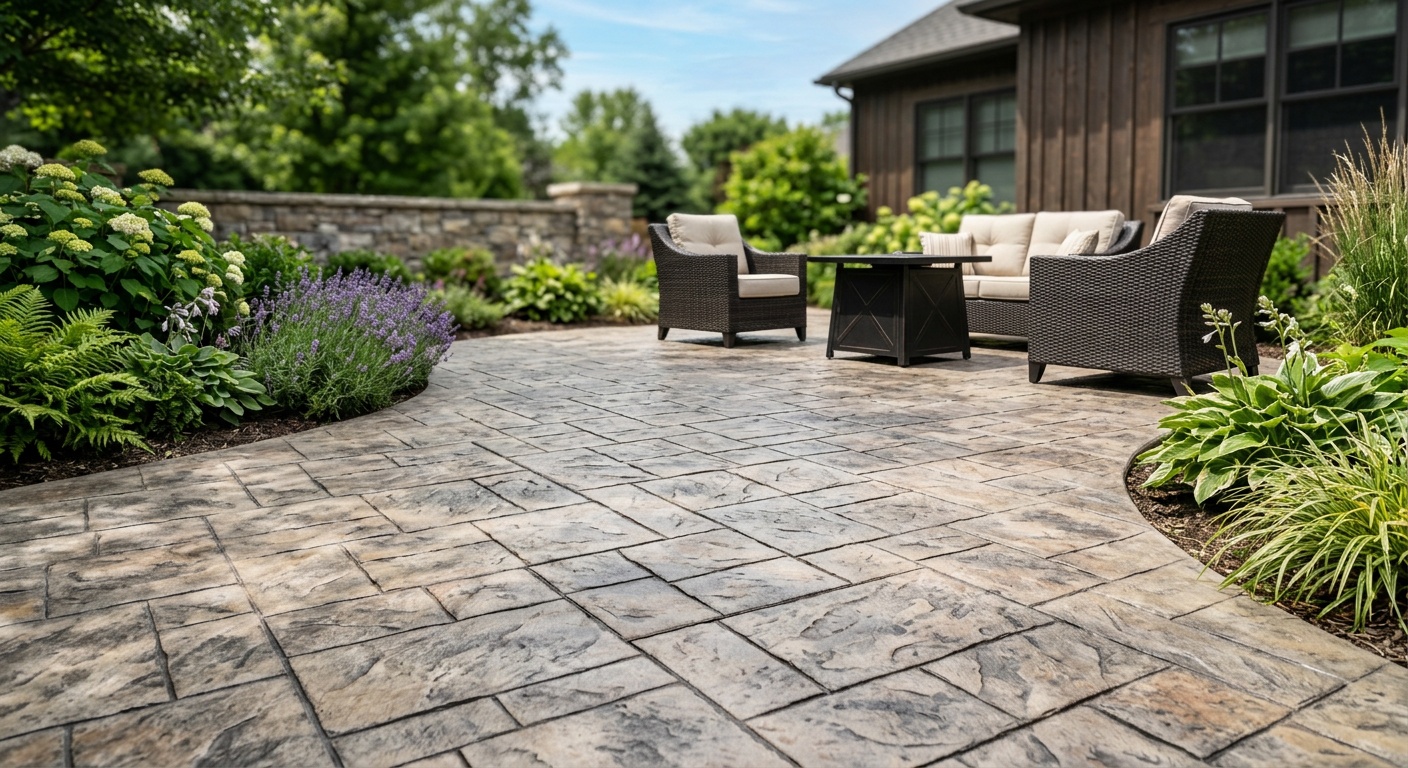
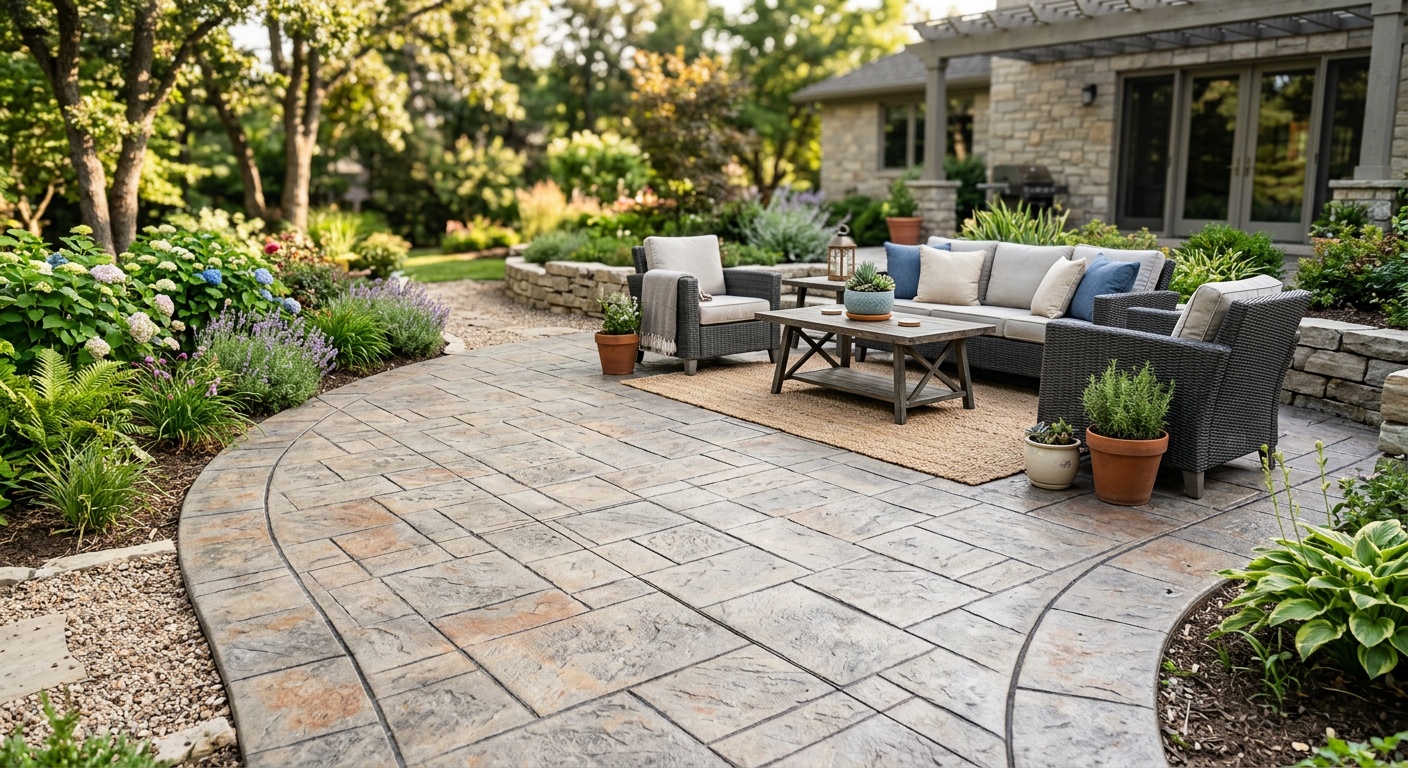
Stamped concrete remains the most widely used decorative technique for outdoor living spaces. The process involves pressing textured patterns into freshly poured concrete before it cures, producing surfaces that convincingly mimic natural stone, brick, slate, cobblestone, and even wood grain.
Modern stamping has evolved dramatically. Today’s polyurethane stamp mats deliver micro-detail precision — individual wood grain lines, natural stone fracture patterns, and multi-directional tile layouts — that were simply unachievable five years ago. Combined with integral pigments and release agents applied in contrasting tones, the result is a surface that doesn’t just look like stone; it tells a story.
Best applications: Patios, pool decks, walkways, driveways, courtyard areas
Average cost range: $12–$22 per square foot (installed, 2026 pricing)
Key advantage: Enormous pattern library — most contractors offer 50+ design options
Exposed Aggregate: Raw Texture with Refined Results
Exposed aggregate concrete strips away the smooth surface layer to reveal the decorative stones, pebbles, shells, or glass embedded within the mix. The result is a naturally textured surface with rich visual depth — and it’s one of the most slip-resistant outdoor finishes available.
In 2026, the trend within exposed aggregate has shifted toward custom aggregate blends. Rather than standard river pebble, savvy designers are specifying mixes that incorporate locally sourced materials: Pacific Coast crushed quartz, Appalachian river stone, or recycled glass in jewel-toned hues. This creates surfaces that feel genuinely regional and distinctive.
Best applications: Pool surrounds (excellent slip resistance), driveways, garden paths, entertaining areas
Average cost range: $8–$18 per square foot
Key advantage: Outstanding durability and traction in wet conditions
Concrete Overlays and Microtopping: The Modern Minimalist’s Canvas
If stamped concrete represents the traditional end of the decorative spectrum, overlays and microtoppings represent its cutting edge. These ultra-thin polymer-modified cement systems — sometimes as thin as 1/16 of an inch — are applied over existing concrete to create seamless, continuous surfaces with a refined, contemporary aesthetic.
Microtoppings in particular have exploded in popularity for outdoor spaces in 2025 and into 2026, largely because they complement the dominant design movements of the moment: minimalism, biophilic design, and the indoor-outdoor blur. A properly applied microtopping on a covered patio can create the illusion of one continuous floor from inside to outside — a highly sought-after effect in modern architecture.
Best applications: Covered patios, outdoor kitchens, modern entertainment areas, renovation of existing slabs
Average cost range: $6–$15 per square foot for overlays; $14–$28 for microtopping systems
Key advantage: Can refresh existing concrete without full removal; unmatched contemporary aesthetic
Acid Staining and Chemical Coloring
Acid staining is a reactive chemical process that penetrates concrete and creates permanent, variegated color effects. Unlike paint or pigment that sits on the surface, acid stains chemically bond with the concrete’s lime content — producing rich, translucent tones in earth hues (browns, tans, terracottas, soft blues and greens) with natural mottling that no two slabs replicate exactly.
Water-based stains, introduced more widely in 2022–2024, now offer an expanded color palette beyond acid staining’s traditional earth tones while maintaining low VOC profiles — an important consideration for eco-conscious homeowners and contractors working in regions with air quality regulations.
Best applications: Patios, covered outdoor areas, decorative borders and medallions
Average cost range: $4–$12 per square foot
Key advantage: Unique, one-of-a-kind finish; no two applications are identical
Engraved and Saw-Cut Concrete
Engraving uses diamond-tipped router bits to carve intricate designs, borders, logos, or patterns directly into cured concrete. Saw-cutting creates geometric grids, diagonal patterns, or custom joint designs that divide large slabs into visually dynamic compositions.
This technique has surged among homeowners wanting permanent, three-dimensional detail that won’t peel or fade — a growing concern as UV exposure and freeze-thaw cycles take their toll on surface-applied finishes over time.
Best applications: Decorative borders, driveway aprons, patio accent areas, custom medallions
Average cost range: $5–$15 per square foot for saw-cutting; $15–$45 for detailed engraving
Design Applications: From Patios to Driveways
Understanding techniques is one thing. Knowing how to deploy them across different outdoor spaces — with an eye for cohesion, function, and visual flow — is where design thinking enters the picture.
Patio Spaces
The patio is where decorative concrete makes its most dramatic statement. In 2026, the most compelling patio designs combine two complementary techniques — for example, a stamped slate field with an engraved decorative border and acid-stained accent bands. This layered approach creates visual interest without overwhelming the space. Color palettes have shifted toward warm neutrals (greige, warm gray, sandstone, terra cotta) that complement natural wood, steel, and plant materials.
Pool Decks
Pool deck concrete has unique requirements: slip resistance, heat reflectivity, and resistance to pool chemicals. The industry’s answer in 2026 is the cool-deck stamped overlay — a textured system engineered to stay 30–40% cooler underfoot than standard concrete while providing the aesthetic of natural stone. Kool Deck and similar thermal-reflective systems have become the gold standard for residential pools in Sun Belt regions.
Driveways
A decorative driveway has a remarkable impact on curb appeal. Exposed aggregate and stamped concrete are the top choices, but the most sophisticated current approach uses a brushed or broom-finished field with stamped or engraved borders — providing the durability needed for vehicle traffic in the center while delivering visual flair at the edges. Saw-cut geometric patterns have also gained significant ground among modern home styles.
Outdoor Kitchens and Bar Areas
Integrated outdoor kitchen countertops cast from polished or microtopped concrete have become a signature element of the premium outdoor living space. Concrete’s ability to be formed into custom shapes — curved counters, built-in planters, fire feature surrounds — makes it unmatched for seamless outdoor kitchen design.
Cost Comparison and ROI
Let’s put the economics in plain terms. Here’s how decorative concrete stacks up against competing outdoor surface materials for a standard 400 sq ft patio project in 2026:
| Material | Avg. Install Cost/sq ft | Lifespan (Years) | Maintenance Level | ROI on Home Value |
|---|---|---|---|---|
| Stamped Concrete | $12–$22 | 25–30+ | Low–Medium | Up to 80% |
| Natural Flagstone | $22–$40 | 30–50+ | Medium–High | Up to 75% |
| Pavers (Concrete/Brick) | $14–$28 | 20–30 | Medium | Up to 72% |
| Wood/Composite Decking | $18–$35 | 15–25 | Medium–High | Up to 65% |
| Plain Concrete Slab | $5–$10 | 25–40 | Low | Up to 50% |
Sources: NAHB Remodeling Market Index 2025; HomeAdvisor Cost Guide Q1 2026; National Concrete Masonry Association
The value proposition is clear: stamped and decorative concrete delivers near-premium aesthetics at a mid-market price point, with a strong ROI relative to installation cost. When you factor in the total cost of ownership — maintenance, repairs, replacement cycles — decorative concrete’s case becomes even more compelling.
Common Challenges and How to Overcome Them
Decorative concrete is powerful, but it’s not foolproof. Three challenges consistently trip up homeowners and even some contractors. Here’s how to navigate each one.
Challenge 1: Cracking and Joint Placement
Concrete cracks. This isn’t a defect — it’s physics. As concrete cures and experiences thermal expansion and contraction, stress must go somewhere. The question is: where do you want that stress to go?
The answer is control joints — planned seams cut or tooled into the slab at regular intervals (typically every 8–12 feet for a patio) that guide cracking beneath the surface in predictable, manageable locations. In decorative concrete, these joints can be designed to become part of the aesthetic — integrated into the pattern as intentional design lines rather than hidden imperfections.
Practical tip: Always request a joint layout drawing from your contractor before work begins. For stamped concrete, joints should align with the stamped pattern’s natural break lines — not cut across them randomly. This is where experienced decorative concrete contractors earn their premium.
Challenge 2: Color Fading and Sealer Maintenance
Decorative concrete color — whether from integral pigments, acid stains, or applied colorants — requires a quality sealer to maintain its vibrancy and protect the surface. And sealers don’t last forever. Most solvent-based acrylic sealers require reapplication every 2–4 years; water-based systems every 3–5 years, depending on sun exposure, traffic, and climate.
The good news: resealing is a DIY-accessible task for most homeowners and costs a fraction of the original installation. The bad news: many homeowners skip it, leading to color bleaching, surface wear, and a gradual loss of the finish they paid for.
Practical tip: Schedule sealer reapplication as part of your annual home maintenance calendar. In 2026, several manufacturers — including Behr and Sherwin-Williams’ concrete division — have introduced UV-stable penetrating sealers with significantly extended service lives of 7–10 years for low-traffic applications.
Challenge 3: Finding a Qualified Contractor
Decorative concrete is a specialized craft. A general concrete contractor who pours flatwork for driveways and sidewalks may not have the colorwork experience, stamp inventory, or overlay skills to execute a complex decorative project correctly. Mistakes — uneven color, off-pattern stamps, poorly timed overlay application — are difficult and expensive to correct after the fact.
Practical tip: Verify membership in the American Society of Concrete Contractors (ASCC) or the Decorative Concrete Council (DCC). Ask for a dedicated portfolio of decorative work — not just general concrete projects. Request references specifically from decorative concrete clients, and visit completed projects in person when possible.
Real-World Case Studies
Case Study 1: The Desert Modern Backyard, Scottsdale AZ (2025)
A homeowner in Scottsdale’s Paradise Valley neighborhood wanted a resort-quality outdoor living space centered around an existing pool. The challenge: the existing aggregate deck was dated, heat-absorbing, and visually disconnected from the home’s newly renovated interior.
The solution was a full overlay system using a cool-reflective microtopping in a warm limestone tone, applied over the existing pool deck (avoiding full demolition), combined with a hand-engraved geometric border pattern inspired by Southwestern textile motifs. Total project cost: $28,400 for approximately 1,100 sq ft. The homeowner reported a 40°F reduction in surface temperature compared to the previous deck and received a $52,000 increase in appraised home value at the next assessment — a 183% return on investment.
Case Study 2: The Urban Rooftop Terrace, Chicago IL (2025)
A Chicago condo building’s shared rooftop terrace was being redesigned as a premium amenity to attract tenants. Weight restrictions ruled out heavy stone or pavers. The design team specified a thin-set stamped overlay system (3/8″ thick) in a large-format slate pattern with charcoal and warm gray tones, sealed with a matte-finish polyurethane sealer rated for freeze-thaw cycles.
The result added minimal structural load while completely transforming the space’s aesthetic from industrial utility to polished urban retreat. The building increased its amenity tier rating, contributing to a 12% increase in lease renewal rates according to the property manager’s 2026 report.
Popularity of Decorative Concrete Techniques Among Residential Projects (2026)
Based on contractor survey data from the Decorative Concrete Council’s 2025 Annual Report, here’s how residential decorative concrete technique adoption breaks down:
Decorative Technique Popularity — Residential Outdoor (2026)
68%
54%
41%
34%
22%
Note: Totals exceed 100% as projects often combine multiple techniques. Source: Decorative Concrete Council Contractor Survey, 2025.
Frequently Asked Questions
How long does decorative concrete last, and does it require significant upkeep?
When properly installed and maintained, decorative concrete outdoor surfaces typically last 25–35 years or longer. The concrete substrate itself is highly durable; what requires periodic attention is the sealer layer, which should be reapplied every 2–5 years depending on the product used and the level of sun and traffic exposure. Annual cleaning with a pH-neutral cleaner and prompt attention to any joint cracking will significantly extend the aesthetic life of the surface. Compared to wood decking (which may need staining annually and replacement in 15–20 years) or pavers (which can shift, heave, and develop weed issues), sealed decorative concrete has a favorable total maintenance profile.
Can decorative concrete be applied over my existing old concrete slab?
In many cases, yes — and this is one of decorative concrete’s most compelling advantages. Overlay systems, microtoppings, stains, and engraving can all be applied to existing slabs, avoiding the cost and waste of full demolition. However, the existing concrete must be structurally sound. Significant cracking, spalling, or subbase failure must be addressed first. A professional contractor will assess the slab with a moisture test and structural evaluation before recommending an overlay approach. For slabs with moderate cosmetic issues only, overlays are generally a highly cost-effective solution — typically 40–60% cheaper than a full replacement pour.
What decorative concrete style works best for a modern or minimalist outdoor aesthetic?
For contemporary and minimalist design sensibilities, microtoppings and seamless overlays are the clear frontrunners in 2026. These systems produce clean, uninterrupted surfaces with a refined, almost architectural quality that complements modern homes with flat rooflines, steel, and glass elements. Color choices for this aesthetic lean toward cool and warm mid-toned grays, warm whites, charcoal, and soft greige. Saw-cut geometric patterns can add structured visual interest without competing with a minimalist composition. Avoid heavily embossed stamp patterns or high-contrast color releases if the goal is contemporary restraint — those techniques, while beautiful, read as more traditional or rustic in character.
Your Decorative Concrete Roadmap: Next Steps
You’ve got the knowledge. Now it’s time to move from inspiration to execution. Here’s your practical roadmap for transforming your outdoor space with decorative concrete — whether you’re starting from scratch or revitalizing what you already have.
- Define your design intent first. Before contacting a single contractor, spend time identifying your aesthetic direction. Is it modern and minimal? Warm and Mediterranean? Rustic and natural? Your style choice will directly determine which techniques belong in your project — and which contractors to seek out.
- Audit your existing slab. If you have existing concrete, don’t assume it needs replacement. Get a professional assessment. You may be a strong overlay candidate, which could cut your project cost significantly while delivering an outstanding result.
- Get at least three contractor quotes — and review portfolios rigorously. Price matters, but technique mastery matters more. Ask specifically about their experience with your chosen technique. Request physical samples of colorwork and patterns before committing.
- Plan your maintenance schedule upfront. Build sealer reapplication into your home maintenance calendar from day one. The single biggest mistake decorative concrete owners make is neglecting this step — don’t be that person.
- Think in zones and flow. The most stunning outdoor spaces use decorative concrete not as a single uniform surface but as a compositional element — different finishes or patterns in the dining zone versus the pool surround versus the walkway — creating a curated sequence of spaces.
As the line between indoor and outdoor living continues to blur in contemporary architecture, decorative concrete sits at that intersection perfectly — durable enough for the elements, refined enough for the design-conscious homeowner. The materials are evolving, the techniques are advancing, and the results speak for themselves in both aesthetic impact and measurable home value.
Here’s the question worth sitting with: If your outdoor space reflected exactly the lifestyle you want to live — not just a functional afterthought, but a genuine extension of your home’s character — what would it look like? Decorative concrete might just be the material that closes that gap.