Best Concrete Finishes for Pool Decks and Wet Outdoor Areas
Best Concrete Finishes for Pool Decks and Wet Outdoor Areas
Reading time: 12 minutes
You’ve just invested in a stunning backyard pool. The water sparkles, the landscaping is lush — and then someone slips on the wet concrete deck. That’s not the memory anyone wants to create. Choosing the right concrete finish for pool decks and wet outdoor areas isn’t just an aesthetic decision; it’s a safety imperative, a durability investment, and honestly, one of the most consequential design choices you’ll make for your outdoor space.
Here’s the straight talk: not all concrete finishes are created equal, and what looks gorgeous bone-dry can become a liability when it’s constantly exposed to water, chemicals, bare feet, and UV radiation. In 2026, with advances in concrete technology and coating systems moving faster than ever, homeowners and contractors have more options — and more decisions — than any previous generation.
This guide cuts through the noise. Whether you’re renovating an existing pool deck or building fresh, we’ll walk you through the best finishes available today, what the data says about performance, and exactly what to look for before you spend a single dollar.
Table of Contents
- Why the Right Finish Matters More Than You Think
- The Top Concrete Finishes for Wet Areas
- Head-to-Head Comparison: Performance Metrics
- Slip Resistance Ratings by Finish Type
- Real-World Case Studies
- 3 Common Challenges and How to Overcome Them
- Practical Tips for Choosing and Maintaining Your Finish
- Frequently Asked Questions
- Your Pool Deck Decision: A Smart Action Plan
Why the Right Finish Matters More Than You Think
Pool deck surfaces endure a brutal combination of stressors that virtually no other residential surface faces: constant water exposure, chlorine and salt splash, freeze-thaw cycles in colder climates, bare-skin contact, intense UV radiation, and the weight of outdoor furniture and equipment. According to the U.S. Consumer Product Safety Commission’s 2025 annual report, slip-and-fall injuries on wet pool decks account for over 43,000 emergency room visits annually in the United States alone — a figure that has remained stubbornly high despite increased awareness.
The surface finish you choose directly influences:
- Slip resistance — measured by the Coefficient of Friction (COF), which determines how much grip bare feet have on wet surfaces
- Heat absorption — dark or dense surfaces can reach 140°F (60°C) in direct summer sun, causing burns
- Chemical resistance — pool chemicals, sunscreen, and algae can degrade unprotected concrete surprisingly fast
- Longevity — a well-chosen and properly applied finish can last 15–25 years; a poor one may need replacement in under five
- Maintenance burden — some finishes require annual resealing; others are largely maintenance-free for a decade
“The most expensive mistake a pool owner can make is choosing a finish based solely on appearance. Safety and durability have to lead the conversation, with aesthetics following closely behind.” — Marcus DeValle, Certified Pool and Spa Contractor, APSP 2025 Excellence Award Recipient
The Top Concrete Finishes for Wet Areas
1. Broom-Finished Concrete
The classic. Broom finishing involves dragging a stiff-bristled broom across freshly poured concrete to create linear texture grooves. It’s the most widely used pool deck finish in North America, and there’s a reason it has endured: it’s affordable, effective, and reliable.
How it works: The broom creates micro-ridges in the surface that interrupt the water film between a foot and the concrete, dramatically improving wet traction. A standard broom finish achieves a wet COF between 0.60 and 0.80 — well above the 0.50 threshold recommended by the Americans with Disabilities Act (ADA) for wet surfaces.
The main drawback? Broom finishes can feel rough on bare feet over time, and the grooves can harbor algae, dirt, and bacteria if not sealed properly. Regular pressure washing and resealing every 2–3 years keeps them in good shape. Cost-wise, broom finishing typically runs $3–$6 per square foot installed in 2026, making it the most budget-accessible option.
2. Exposed Aggregate Finish
Exposed aggregate is where function meets serious visual appeal. This finish is created by seeding decorative stones, pebbles, or shells into the top layer of concrete, then washing and brushing away the surface cement paste to reveal the embedded material beneath.
The result is a naturally textured, visually rich surface that provides excellent slip resistance because of the three-dimensional profile of the aggregate particles. Wet COF values for exposed aggregate typically range from 0.65 to 0.85 depending on aggregate size and density. The texture also diffuses heat more effectively than smooth surfaces, making it more comfortable underfoot in summer.
The trade-off? Exposed aggregate can be uncomfortable on sensitive or young skin if the aggregate is too coarse. The quality of the sealer applied on top significantly influences both longevity and ease of cleaning. Premium exposed aggregate installations in 2026 range from $8–$18 per square foot depending on aggregate type and regional labor costs.
3. Stamped Concrete
Stamped concrete has evolved dramatically since its mid-2000s peak. In 2026, third-generation polymer-modified stamping systems create impressions of natural stone, slate, wood planks, and brick with remarkable realism — and more importantly, with engineered surface textures that prioritize safety.
The critical word here is engineered. Early stamped concrete fell out of favor for wet areas because the stamps created smooth, low-profile impressions that became dangerously slick when wet. Modern systems incorporate micro-texture stamps and are paired with anti-slip sealers containing silica sand or aluminum oxide additives. When properly specified, contemporary stamped concrete achieves wet COF values of 0.55–0.75.
Stamped concrete requires the most maintenance of any option — typically annual resealing with a high-quality penetrating or topical sealer. But for homeowners who prioritize aesthetics and are committed to upkeep, the visual results are unmatched. Expect to pay $12–$22 per square foot installed.
4. Salt Finish Concrete
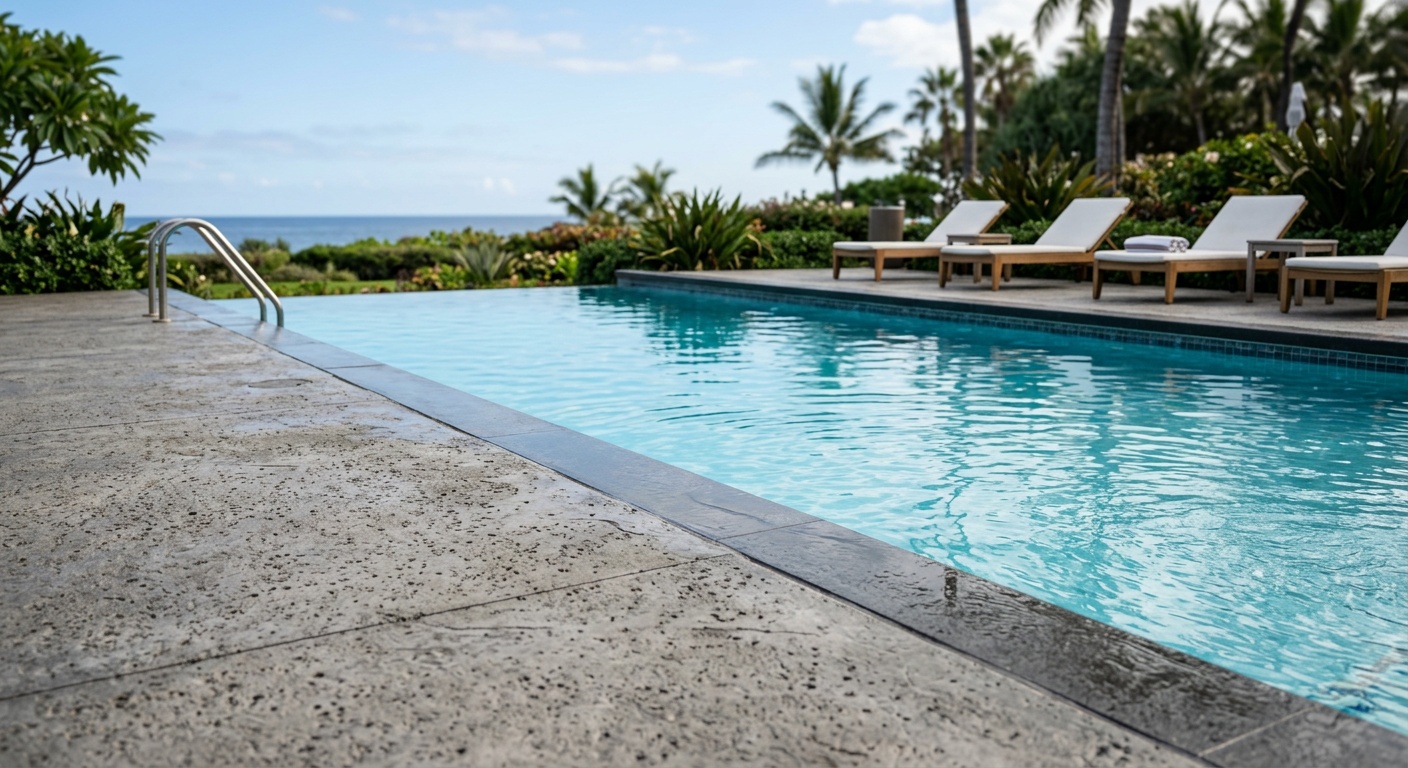
Salt finishing is an underappreciated gem for pool decks. During the finishing process, rock salt crystals are pressed into the fresh concrete surface, then dissolved with water after curing, leaving behind a constellation of small pits and voids. The result is a subtle, natural-looking texture reminiscent of stone.
Salt finish provides excellent wet traction (COF 0.60–0.75) while being gentler on bare feet than broom or exposed aggregate. It also has a cooler surface temperature than denser finishes because the pits reduce the overall contact surface area with the sun. In warm climates like Florida, Arizona, and Southern California — the top three states for residential pool construction in 2025 — salt finish is increasingly specified by architects.
One important caveat: salt finish is not recommended for climates with hard freeze-thaw cycles. The pits can trap water, which expands during freezing and accelerates surface deterioration. In temperate to warm climates, however, it’s an outstanding choice at $5–$10 per square foot.
5. Microtop / Concrete Overlay Systems
For existing pool decks that need a refresh without full demolition, concrete overlay systems — sometimes called microtop, skim coat, or thin-set overlays — have become the go-to renovation solution. These polymer-modified cementitious systems are applied at thicknesses of 1/16 to 1/4 inch over existing concrete, resurfacing and refinishing the deck at a fraction of replacement cost.
Modern overlay systems in 2026 include purpose-formulated anti-slip additives and UV-stable pigments. When properly bonded to a sound substrate and sealed with a penetrating sealer, overlays can last 8–15 years in residential applications. They’re particularly popular in resort and commercial settings where rapid renovation with minimal downtime is essential. Overlay systems run $6–$14 per square foot installed.
Head-to-Head Comparison: Performance Metrics
| Finish Type | Wet COF Range | Cost ($/sq ft) | Maintenance Level | Lifespan (Years) |
|---|---|---|---|---|
| Broom Finish | 0.60–0.80 | $3–$6 | Low–Medium | 15–25 |
| Exposed Aggregate | 0.65–0.85 | $8–$18 | Low–Medium | 20–30 |
| Stamped Concrete | 0.55–0.75 | $12–$22 | High | 10–20 |
| Salt Finish | 0.60–0.75 | $5–$10 | Low | 15–20 |
| Concrete Overlay | 0.58–0.78 | $6–$14 | Medium | 8–15 |
Slip Resistance Ratings by Finish Type (Wet COF Max Values)
The following chart compares the maximum wet Coefficient of Friction (COF) achieved by each finish type under ideal application conditions. Higher values indicate better wet traction performance.
ADA minimum wet COF threshold: 0.50 | Values reflect optimal application under controlled conditions
Real-World Case Studies
Case Study 1: Luxury Resort Renovation in Scottsdale, Arizona (2025)
The Sonoran Ridge Resort in Scottsdale faced a critical challenge in mid-2025: its 12-year-old pool deck, finished with early-generation stamped concrete, had developed severe surface sealer degradation and micro-cracking from the intense Arizona UV exposure and seasonal monsoon moisture cycles. Guest complaints about slippery surfaces during the wet season had increased for two consecutive years, and the facility’s liability insurance carrier flagged the deck for mandatory remediation.
The renovation team chose a dual-strategy approach: in high-traffic areas around the main pool and water features, they applied a polymer-modified exposed aggregate overlay using locally sourced Arizona river rock aggregate. In quieter lounging zones, they used a microtop overlay with anti-slip aluminum oxide additive in a warm terracotta tone that complemented the resort’s Southwestern aesthetic.
The results were quantifiable: post-project slip resistance testing confirmed wet COF values of 0.79 in aggregate zones and 0.72 in microtop zones — both well above the liability-triggering threshold. Total project cost was approximately $285,000 for 22,000 square feet. The resort’s insurance carrier subsequently reduced their premises liability premium by 18% for the 2026 policy year, directly citing the documented surface safety improvements.
Case Study 2: Residential Pool Deck Upgrade in Tampa, Florida (2026)
Maria and David Chen purchased a 1998-era home in Tampa in late 2025 with an existing broom-finished pool deck that was functional but aesthetically dated. Their contractor assessed the existing slab — structurally sound, minor surface crazing — and recommended a salt-finish overlay rather than full demolition and repour, which would have cost roughly three times more.
The project, completed in February 2026, used a cementitious overlay system at 3/16-inch thickness, hand-worked to replicate a salt finish texture, then sealed with a UV-stable penetrating sealer. Total cost: $9,400 for approximately 900 square feet. The Chens reported that barefoot comfort was noticeably superior to the old broom finish, and the surface temperature — measured on a 94°F Tampa afternoon — registered 118°F compared to 137°F on a neighbor’s un-upgraded broom finish deck, a meaningful difference for families with young children.
3 Common Challenges and How to Overcome Them
Challenge 1: Sealer Failure and Surface Slipperiness
The single most common complaint from pool deck owners is that their surface becomes dangerously slippery after a few years. In the vast majority of cases, the culprit isn’t the base finish — it’s sealer degradation. Topical acrylic sealers, which are inexpensive and widely used, break down under UV exposure and chlorine splash, creating a thin, smooth film that is ironically more slippery than bare concrete.
The fix: Specify a penetrating silane-siloxane sealer rather than a topical acrylic from the outset. Penetrating sealers bond within the concrete pores rather than forming a surface film, providing water repellency without altering the texture profile. For existing decks with topical sealer, a professional chemical stripper application followed by resealing with a penetrating product is the appropriate remediation. Cost: $1.50–$3.00 per square foot for professional resealing.
Challenge 2: Heat Retention on Dark or Dense Surfaces
In sunbelt climates, concrete surface temperature is a genuine quality-of-life and safety issue. Dark stamped concrete can exceed 145°F (63°C) in peak summer conditions — hot enough to cause burns within seconds on bare skin. The 2025 Concrete Decor Industry Report noted that heat comfort complaints represent 31% of all negative feedback in residential pool deck projects in states like Texas, Nevada, and Florida.
The fix: Specify light-colored concrete mixes or pigments, as color has the most significant impact on heat absorption. White or light gray concrete can run 20–30°F cooler than dark charcoal under identical conditions. Additionally, aggregate finishes that create air pockets in the surface profile (exposed aggregate, salt finish) reduce conductive contact area and surface temperature. Cool-deck coating systems — originally developed in the 1960s and dramatically improved with ceramic microsphere technology by 2026 — can reduce surface temperatures by 20–35°F compared to standard sealed concrete and are worth serious consideration in hot climates.
Challenge 3: Efflorescence and Staining Around Pool Edges
Efflorescence — the white, chalky mineral deposits that migrate to the concrete surface as water evaporates — is particularly common on pool decks because of the constant wet-dry cycling near pool edges and splash zones. Left untreated, it can degrade sealer adhesion, create surface roughness inconsistencies, and signal underlying moisture migration problems.
The fix: Efflorescence on an unsealed or penetrating-sealed surface is largely cosmetic and can be removed with a diluted muriatic acid wash or purpose-formulated efflorescence cleaner. The preventive approach is to ensure proper drainage design so the deck slopes away from the pool edge at a minimum of 1/8 inch per foot (the industry standard is 1/4 inch per foot), preventing water from sitting long enough to wick into the slab. At the design stage, integral water repellent admixtures added to the concrete mix itself significantly reduce moisture migration and subsequent efflorescence.
Practical Tips for Choosing and Maintaining Your Finish
Before you sign a contract, run through this decision framework:
- Climate first. Cold-climate zones (USDA zones 3–6) should eliminate salt finish and be cautious with exposed aggregate sealers that can trap water in freeze-thaw cycles. Prioritize broom finish or overlay systems with interior-reinforced concrete mixes.
- User profile matters. Households with young children or elderly members should weight wet COF as the primary metric and lean toward exposed aggregate or premium broom finish. High-design households with adult-only pools have more latitude for stamped concrete with proper anti-slip sealer.
- Get COF documentation. Ask your contractor to provide third-party wet COF test data for the specific finish and sealer combination they’re proposing. Any reputable supplier will have this data. If they can’t provide it, consider that a red flag.
- Don’t underestimate sealer quality. The sealer is not an accessory — it’s 50% of the finished system’s performance. Budget for a premium penetrating sealer and re-application every 3–5 years rather than a cheap topical sealer that requires annual attention.
- Plan for drainage. The best finish in the world performs poorly if water pools on the deck. Confirm your contractor is specifying a minimum 1/4-inch-per-foot slope away from the pool and any structure, with adequate drain points.
- Consider a sample panel. For projects over $15,000, always request a minimum 4×4-foot sample panel of the proposed finish in the actual project colors and aggregate before full installation. What you see on a contractor’s phone screen or showroom sample board can look dramatically different on a full sun-exposed pool deck.
Frequently Asked Questions
What is the safest concrete finish for a pool deck with young children?
For households with young children, exposed aggregate finish consistently provides the best combination of high wet slip resistance and durability. Opt for smaller aggregate sizes (pea gravel or 3/8-inch crushed stone) to balance traction with barefoot comfort. Pair it with a penetrating sealer that includes an anti-slip additive for maximum safety. Broom finish is an excellent budget-conscious runner-up, particularly a medium-bristle broom texture that creates adequate grip without being abrasive on sensitive skin.
How often does a concrete pool deck need to be resealed?
Resealing frequency depends heavily on the sealer type and your climate. Topical acrylic sealers in high-UV climates (Florida, Arizona, California) typically need reapplication every 1–2 years. Premium penetrating silane-siloxane sealers generally last 3–7 years before reapplication is warranted. A simple water-bead test confirms whether resealing is needed: pour a cup of water on the surface; if it soaks in within 30 seconds rather than beading up, it’s time to reseal. In 2026, professional resealing services average $1.75–$3.50 per square foot nationwide.
Can I change my existing concrete pool deck finish without tearing it out?
In most cases, yes — provided the existing slab is structurally sound with no significant cracking, heaving, or delamination. Concrete overlay systems have revolutionized pool deck renovation, allowing new textures, colors, and slip profiles to be applied at 1/16 to 1/4-inch thickness over existing concrete. A professional assessment of the existing slab is essential before committing to an overlay; if the substrate has moisture transmission issues or structural deficiencies, overlays will fail prematurely. For structurally compromised decks, a partial or full replacement is the correct long-term decision, even if higher cost upfront.
Your Pool Deck Decision: A Smart Action Plan
You’ve now got the comprehensive picture. But information without action is just noise. Here’s your practical roadmap to making the best possible pool deck finish decision:
- Assess your existing slab (or plan your pour). If renovating, hire a concrete specialist for a structural and moisture assessment before specifying any finish. This $200–$400 inspection can save you from a $15,000 overlay failure two years later.
- Match finish to your actual life. Be honest about maintenance commitment, family composition, climate, and budget. The “best” finish is the one you’ll maintain properly and that serves your household’s real daily patterns.
- Request COF documentation. Before any contract is signed, confirm the wet Coefficient of Friction for the proposed finish-sealer system. Aim for 0.65 or above for pool deck applications.
- Specify the sealer in writing. Ensure your contract specifies the exact sealer product by brand and formulation — not just “penetrating sealer.” This eliminates contractor substitution with inferior products.
- Schedule maintenance before you need it. Set a calendar reminder for your first sealer assessment 18 months post-installation, then every 3 years after. Proactive maintenance is 80% cheaper than reactive repair.
As 2026 advances, the intersection of concrete technology and outdoor living design continues to accelerate. Photocatalytic concrete coatings that break down algae and organic growth, thermally reflective aggregate systems, and bio-based penetrating sealers are all moving from specialty products to mainstream availability. The pool decks being installed or renovated today will exist in a very different material landscape by 2030 — but the fundamentals of safety, durability, and thoughtful specification will always be the foundation.
Your outdoor space is an extension of how you live. The surface under your feet at the water’s edge shouldn’t be an afterthought — it should be a deliberate, informed choice. What finish will you trust with your family’s comfort and safety?