Stamped Concrete vs Pavers: Which Is Best for Your Backyard
Stamped Concrete vs Pavers: Which Is Best for Your Backyard in 2026?
Reading time: 12 minutes
Picture this: It’s a warm Saturday afternoon, and you’re standing in your backyard, coffee in hand, staring at a cracked, weathered patio that’s seen better days. You know it’s time for an upgrade — but should you go with stamped concrete or pavers? The decision feels overwhelming, especially when both options promise beauty, durability, and that coveted outdoor living aesthetic you’ve been dreaming about.
Here’s the straight talk: Both options are genuinely excellent choices — but they serve different homeowners, different climates, and different budgets. The right answer isn’t universal. It’s personal. And this guide will help you navigate that decision with confidence.
In 2026, outdoor living space investment continues to surge. According to the American Society of Landscape Architects’ 2025 Residential Landscape Architecture Trends Survey, patio and hardscape upgrades remained in the top three most-requested residential improvements, with homeowners spending an average of $8,500–$18,000 on backyard hardscape projects. The stakes are high — and so is the potential return on investment.
Let’s break down everything you need to know to make the smartest choice for your backyard.
Table of Contents
- Quick Overview: What Are We Actually Comparing?
- Cost Breakdown: Installation and Long-Term Economics
- Durability and Maintenance: The Real-World Test
- Aesthetics and Design Flexibility
- Climate Considerations: Where You Live Matters
- Real Homeowner Stories: Two Backyards, Two Choices
- Head-to-Head Comparison Table
- Performance Ratings at a Glance
- 3 Common Challenges and How to Overcome Them
- Frequently Asked Questions
- Your Backyard Decision Roadmap
Quick Overview: What Are We Actually Comparing?
Before diving into the details, let’s establish a clear baseline. Both stamped concrete and pavers are popular hardscape solutions, but they’re fundamentally different in how they’re made, installed, and maintained.
What Is Stamped Concrete?
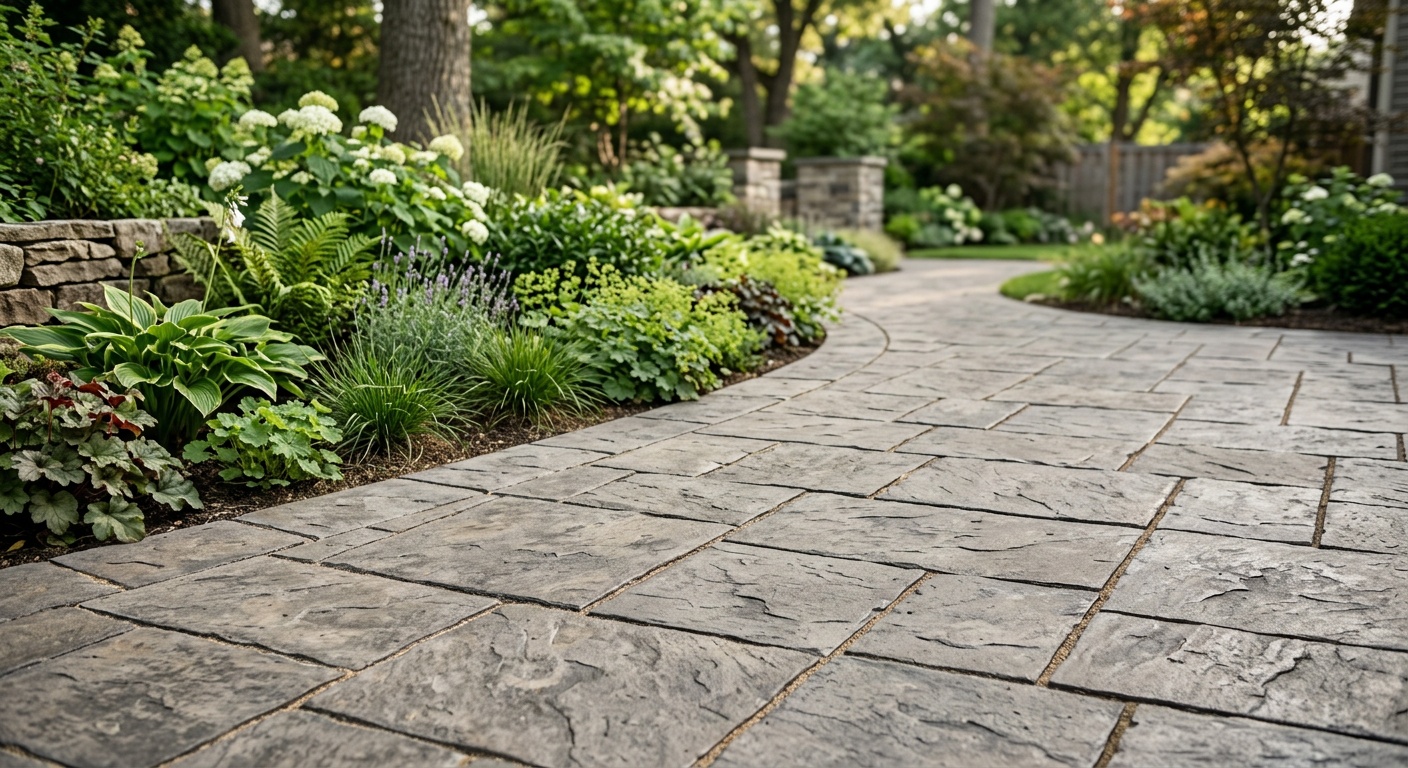
Stamped concrete is a poured concrete surface that’s textured and patterned before it fully cures, using rubber stamps to mimic the appearance of natural stone, brick, slate, wood planks, or cobblestone. Color pigments and release agents are added to enhance the visual effect. Once sealed, it can look strikingly realistic and luxurious at a fraction of the cost of natural materials.
The process involves pouring a concrete slab, adding color, pressing the stamps into the wet surface, then applying a sealer once cured. The result? A seamless, continuous surface with virtually no joints.
What Are Pavers?
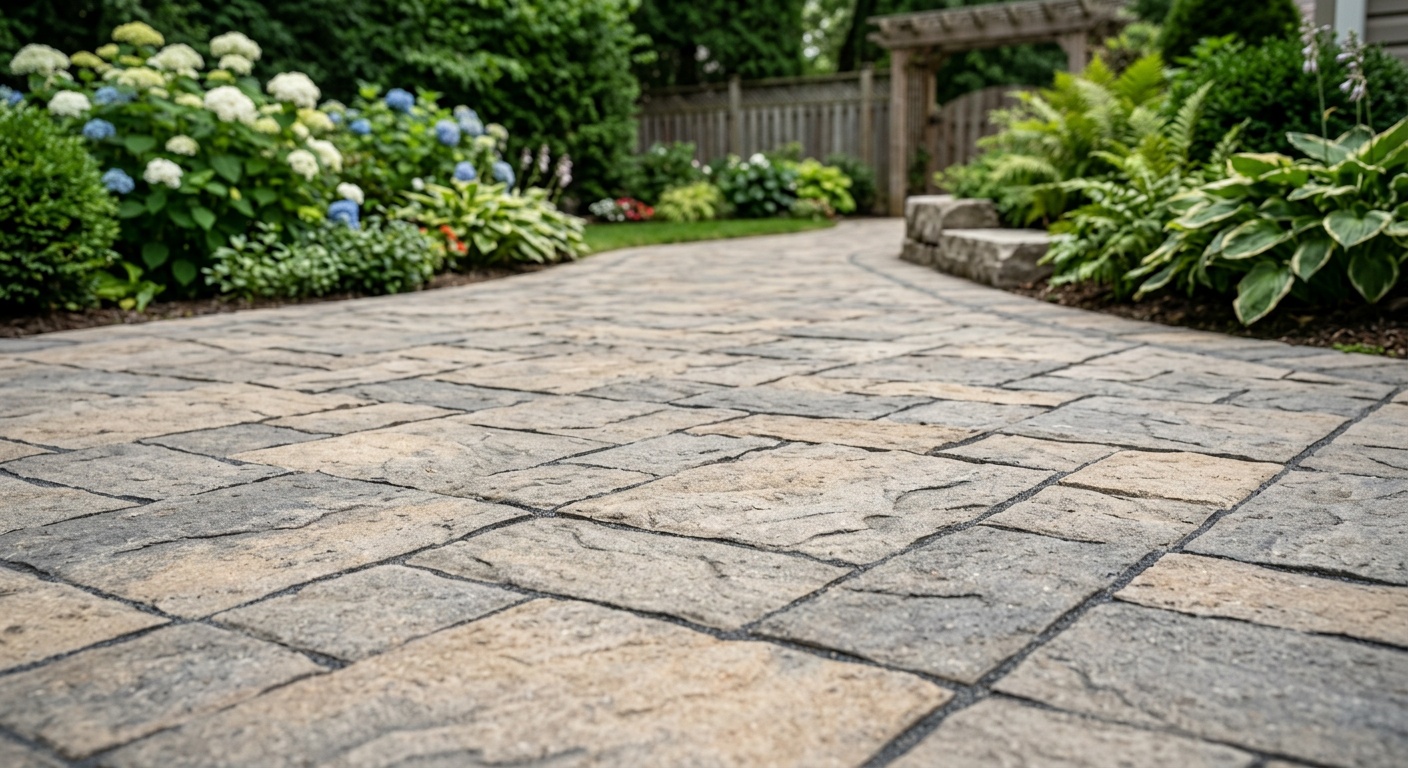
Pavers are individual interlocking units — typically made from concrete, natural stone, clay brick, or porcelain — that are laid over a compacted gravel base and sand bed. Unlike stamped concrete, pavers are modular. They create a surface composed of many individual pieces, which is precisely what gives them their signature look and their key structural advantage.
In 2026, porcelain pavers have seen a dramatic rise in popularity, offering the look of natural stone with significantly better stain and frost resistance. Concrete pavers remain the market leader by volume, while natural travertine and bluestone continue to command premium price points.
Cost Breakdown: Installation and Long-Term Economics
Let’s talk numbers, because budget is often the deciding factor — and the cost picture here is more nuanced than most contractors will tell you upfront.
Upfront Installation Costs in 2026
Based on national averages compiled from contractor data in early 2026:
- Stamped Concrete: $12–$22 per square foot installed (basic single-color patterns start at $12; complex multi-color, multi-pattern designs run $18–$22+)
- Concrete Pavers: $15–$30 per square foot installed
- Natural Stone Pavers: $25–$55 per square foot installed
- Porcelain Pavers: $20–$40 per square foot installed
- Brick Pavers: $14–$25 per square foot installed
On a standard 400-square-foot patio, stamped concrete typically costs $4,800–$8,800, while concrete pavers average $6,000–$12,000. That’s a meaningful difference for most homeowners.
But here’s what the upfront numbers don’t show: long-term maintenance costs can flip the economics entirely.
The 10-Year Cost Reality
Stamped concrete requires resealing every 2–4 years. In 2026, professional resealing runs approximately $1.50–$3.00 per square foot. For a 400 sq ft patio, that’s $600–$1,200 every few years. Over a decade, you’re looking at $1,800–$3,600 in maintenance costs — before any crack repairs, which can run $300–$800 per incident.
Pavers, by contrast, are largely self-maintaining. Individual damaged pavers can be replaced for a few dollars each. Occasional joint sand replenishment runs $200–$400 per application. Their 10-year maintenance cost for the same patio footprint: typically $400–$900.
Pro Tip: When getting contractor quotes, always ask for a 10-year cost estimate that includes maintenance. Most homeowners focus on Day 1 cost and are surprised by the long-term picture.
Durability and Maintenance: The Real-World Test
Durability is where the two options diverge most sharply — and where your local climate plays a critical role.
Stamped Concrete: Strength and Vulnerability
Stamped concrete is essentially a standard concrete slab with decorative surface treatment. It’s a monolithic structure, which is both its greatest strength and its greatest weakness.
Strengths:
- Highly resistant to surface wear under normal foot traffic
- Seamless surface resists weeds and insect intrusion
- Can support heavy loads (vehicles, heavy planters, spas)
- Easier to keep clean — no gaps for debris to collect
Vulnerabilities:
- Concrete naturally cracks as it expands and contracts — especially in freeze-thaw climates
- Once cracked, repairs are difficult to make invisible
- Surface fading is inevitable without regular resealing
- De-icing salts (used in snowy climates) can cause severe surface spalling
- Heaving from tree roots or ground movement creates permanent damage
A telling industry statistic: according to a 2025 survey by the Concrete Decor Institute, approximately 65% of stamped concrete surfaces develop visible cracking within 10 years in climates that experience significant seasonal temperature swings.
Pavers: Flexible by Design
Pavers are inherently more forgiving. Because the surface consists of individual interlocking units with joints between them, movement from ground shifts, freeze-thaw cycles, or settling is accommodated naturally. Rather than one long crack through a slab, a small section of pavers might shift slightly and can simply be reset.
Paver durability highlights:
- Individual unit replacement eliminates costly full-surface repairs
- Interlocking design maintains structural integrity despite ground movement
- Permeable paver options allow water drainage directly through the surface
- ICPI (Interlocking Concrete Pavement Institute) certified pavers are tested to withstand 8,000+ PSI
- No sealing required (though optional sealing enhances color and stain resistance)
The trade-off: paver joints can become home to weeds if polymeric sand is not used or degrades over time. In 2026, premium polymeric sand products now carry 10-year weed suppression warranties, largely resolving this historically significant concern.
Aesthetics and Design Flexibility
This is where personal preference genuinely drives the decision — and both options have legitimate claim to the aesthetic crown, just in different ways.
Stamped concrete excels in: creating seamless, flowing surfaces. A stamped concrete patio can look like one continuous piece of aged flagstone or wood-plank decking with no interruption. It’s elegant in a minimalist, modern sense. Design continuity is effortless.
Pavers excel in: intricate pattern versatility and visual texture. Herringbone, basketweave, running bond, circular patterns, mixed-color blends — the design possibilities are architecturally rich. In 2026, large-format porcelain pavers (24″x48″) have become a major trend, offering a contemporary, clean aesthetic that pairs beautifully with modern home architecture.
Color is another important dimension. Stamped concrete color tends to fade over time and requires maintenance to preserve vibrancy. Paver color is integral to the unit itself and, while it may slightly mellow over time, retains its character without intervention.
Design Insight: Consult with a landscape architect or experienced hardscape contractor before finalizing your choice. Many homeowners who went with stamped concrete for its “seamless look” later wished they had chosen pavers for repairability. Conversely, homeowners who wanted a flowing, artistic pattern often found pavers gave them more creative freedom than anticipated.
Climate Considerations: Where You Live Matters
If there’s one factor that should heavily influence your decision and is consistently underweighted by homeowners, it’s climate.
- Cold climates (Midwest, Northeast, Mountain West): Pavers are strongly preferred. The freeze-thaw cycle is stamped concrete’s worst enemy. Water infiltrates surface microcracks, freezes, expands, and progressively destroys the surface — particularly if de-icing salts are used. Pavers handle these conditions dramatically better.
- Hot, arid climates (Southwest, Southern California): Both options perform well. Stamped concrete has less freeze-thaw risk, though UV exposure still requires regular resealing. Light-colored pavers reflect heat better, making paver surfaces more comfortable to walk on barefoot in peak summer.
- Humid, subtropical climates (Southeast, Gulf Coast): Both can work, but pavers require attention to moss and algae growth in joint sand. Sealed stamped concrete holds up well here if properly maintained.
- High rainfall regions (Pacific Northwest): Permeable pavers offer a drainage advantage that’s both practical and increasingly relevant for stormwater management compliance requirements that several municipalities have introduced in 2025–2026.
Real Homeowner Stories: Two Backyards, Two Choices
Case Study 1: The Thompson Family, Minneapolis, Minnesota
In spring 2025, the Thompsons replaced a deteriorating wood deck with a 500-square-foot hardscape patio in their Twin Cities backyard. Their contractor recommended pavers for one primary reason: Minneapolis winters. After researching both options extensively, they chose tumbled concrete pavers in a charcoal blend with a running bond pattern.
Total installed cost: approximately $11,200. One year later, after their first Minnesota winter, the patio showed zero signs of frost heave or cracking. “Our neighbor went with stamped concrete the same summer,” said homeowner Rachel Thompson. “By March, she had a 4-foot crack across her patio. Our patio looks exactly the same as day one.”
Their maintenance in year one: zero. Total spend beyond installation: $0.
Case Study 2: The Garcias, Scottsdale, Arizona
The Garcia family wanted a seamless, resort-style pool deck that would complement their Spanish-style home. They chose stamped concrete in a Saltillo tile pattern with terracotta color tones — a look that pavers would have struggled to replicate as convincingly without significant cost.
Installed cost: $9,800 for 650 square feet. In Scottsdale’s climate, freeze-thaw cracking is essentially not a concern. Their experience three years in: minor fading that was easily addressed with a single resealing at a cost of approximately $780.
“For our aesthetic goals in this climate, stamped concrete was absolutely the right call,” noted homeowner Miguel Garcia. “We got the seamless look we wanted at a better price point than the natural stone pavers we originally considered.”
Both families made the right choice — for their specific circumstances. That’s the key insight.
Head-to-Head Comparison Table
| Category | Stamped Concrete | Pavers |
|---|---|---|
| Upfront Cost (per sq ft) | $12–$22 | $15–$55 |
| 10-Year Maintenance Cost (400 sq ft) | $1,800–$3,600+ | $400–$900 |
| Freeze-Thaw Performance | ⚠️ Poor | ✅ Excellent |
| Repairability | ⚠️ Difficult | ✅ Easy |
| Design Versatility | ✅ High (seamless) | ✅ Very High (modular) |
| Estimated Lifespan | 15–25 years | 25–50+ years |
Performance Ratings at a Glance
The following chart compares both options across five key performance dimensions, scored out of 10 based on aggregated contractor and homeowner data from 2025–2026:
Durability (Cold Climates)
Upfront Affordability
Long-Term Value
Aesthetic Seamlessness
DIY Repair Ease
3 Common Challenges and How to Overcome Them
Challenge 1: The Cracking Problem with Stamped Concrete
Cracking is the most cited complaint about stamped concrete — and it’s largely unavoidable in the long run. Concrete expands and contracts with temperature changes, and cracks are a natural result. However, the severity and visibility of cracking can be dramatically reduced with proper installation techniques.
Solution: Insist that your contractor installs control joints every 8–10 feet throughout the stamped surface. Control joints are intentional weak points that encourage cracking to occur in predictable, manageable lines rather than randomly across your beautiful pattern. Many inexperienced contractors skip or minimize control joints for aesthetic reasons — don’t let them. Also request a minimum 4-inch slab thickness with fiber mesh or rebar reinforcement.
Challenge 2: Weed and Ant Intrusion in Paver Joints
The Achilles’ heel of traditional paver installations has long been joint maintenance — weeds sprouting between units and ants undermining the sand bed. In past years, this required annual attention.
Solution: In 2026, this challenge is largely solved. Specify polymeric joint sand with a weed suppression warranty of at least 7 years. Premium products like Alliance Gator SuperSand Bond G2 and Belgard’s SEK-Surebond products now offer documented 10-year performance data. For ant intrusion specifically, request that your contractor applies a perimeter pest barrier treatment at installation. The incremental cost is minimal — roughly $150–$300 — and the peace of mind is significant.
Challenge 3: Finding a Qualified Contractor
Perhaps the single greatest risk factor in both stamped concrete and paver projects is contractor quality. A mediocre stamped concrete job will crack prematurely and look amateur. A poorly installed paver base will shift, settle unevenly, and create drainage problems.
Solution: For pavers, look for ICPI-certified contractors (Interlocking Concrete Pavement Institute certification). For stamped concrete, ask to see a portfolio of work that is at least 3–5 years old — this reveals how their work holds up over time, not just how it looks at installation. Always request three references from projects completed at least two years prior, and actually call them. In 2026, the National Concrete Masonry Association and local chapter contacts can also provide verified contractor referrals.
Frequently Asked Questions
Is stamped concrete slippery when wet, and how does it compare to pavers for pool decks?
This is a critical safety consideration for pool surrounds. Stamped concrete can be slippery when wet, particularly when the sealer has a high-gloss finish. However, anti-slip additives (aluminum oxide or silica sand) can be mixed into the sealer to substantially improve traction. Pavers, by contrast, naturally provide better grip due to their textured surfaces and joint lines. For pool decks specifically, pavers — particularly tumbled or brushed-finish units — are generally considered the safer choice. If you prefer stamped concrete for a pool area, always specify a matte or low-sheen sealer with anti-slip additive, and budget for more frequent resealing as pool chemicals accelerate sealer degradation.
Can pavers be installed as a DIY project to save money?
Technically, yes — and many homeowners tackle small paver projects successfully. However, the critical variable is base preparation, which accounts for roughly 40% of a paver installation’s long-term performance. Proper base construction requires excavation to appropriate depth (typically 6–8 inches for patios), compacted gravel base, precise screeded sand layer, and correct slope for drainage. Errors in these foundational steps result in settlement, rocking pavers, and drainage problems that can cost more to fix than professional installation would have cost originally. If DIY appeals to you, limit it to small accent areas (under 100 sq ft) and invest significant time in learning base preparation techniques before starting. Stamped concrete, conversely, is not a realistic DIY project and should always be professionally installed.
Which option adds more resale value to a home in 2026?
According to real estate data aggregated by the National Association of Realtors and Remodeling Magazine’s 2025 Cost vs. Value Report, well-installed paver patios typically recover 60–75% of installation cost in resale value, compared to 50–65% for stamped concrete. The gap has widened slightly in recent years as buyer awareness of stamped concrete’s maintenance requirements has increased. That said, geographic market dynamics matter significantly — in high-end markets where outdoor living is a premium feature, either option can command strong returns. The quality of installation matters as much as the material choice; a pristine stamped concrete patio in a warm climate is more appealing to buyers than a poorly maintained or cracked one.
Your Backyard Decision Roadmap: 5 Steps to Making the Right Call
You’ve absorbed a lot of information. Now let’s transform it into a clear, actionable path forward. Here’s your decision roadmap:
- Assess your climate first. If you live in a freeze-thaw climate (USDA Plant Hardiness Zones 5 and below), pavers should be your strong default choice unless you have a compelling aesthetic reason for stamped concrete and fully understand the maintenance implications.
- Calculate the 10-year total cost, not just Day 1 cost. Use the maintenance figures from this guide to build a realistic long-term budget. In many cases, pavers’ higher upfront cost is offset within 7–8 years through lower maintenance expenses.
- Define your aesthetic priority. Do you want seamless, flowing continuity (lean toward stamped concrete) or intricate pattern versatility and modular flexibility (lean toward pavers)? Pull inspiration images and share them with at least two contractors for input.
- Vet contractors rigorously. Request ICPI certification for paver work, multi-year portfolio evidence for stamped concrete, and real references from completed projects. The contractor matters as much as the material.
- Request material samples and mock-ups. Many reputable contractors will create small sample boards or mock sections. Seeing actual materials in your outdoor light conditions, next to your home’s exterior, is invaluable before committing thousands of dollars.
In the broader context of 2026’s outdoor living trends — where backyards are increasingly viewed as extensions of interior living space, and where sustainability and durability are rising priorities — both options have a legitimate place. Permeable pavers align particularly well with the growing municipal push for responsible stormwater management. Stamped concrete’s lower material intensity gives it a smaller embodied carbon footprint per square foot. Neither is objectively superior across all dimensions.
The question isn’t really “Which is better?” — it’s “Which is better for you, your climate, your budget, and your lifestyle?”
You now have the framework to answer that question with confidence. The only thing left is to grab those contractor quotes, walk your backyard one more time, and start turning that vision into reality. What will your backyard become?