How Much Does a New Concrete Patio Cost to Install
How Much Does a New Concrete Patio Cost to Install in 2026?
Reading time: 12 minutes
You’ve been dreaming about that perfect outdoor living space — a smooth, durable concrete patio where summer barbecues happen and morning coffees feel like a ritual. But then comes the question that stops most homeowners cold: How much is this actually going to cost me?
Here’s the straight talk: concrete patio installation costs in 2026 range from $1,800 to $12,000+, with the national average hovering around $4,200 for a standard 400-square-foot patio. But that number alone won’t help you budget wisely. The real answer depends on your design choices, your region, the contractor you hire, and a handful of factors most homeowners never think to ask about.
This guide cuts through the noise and gives you the precise, actionable cost breakdown you need to make a confident investment in your outdoor space — whether you’re working with a lean budget or going all-in on a luxury outdoor room.
Table of Contents
- 2026 Cost Overview at a Glance
- Key Factors That Drive Your Final Price
- Concrete Finish Types and Their Costs
- DIY vs. Professional Installation
- Regional Cost Differences Across the U.S.
- Real Homeowner Examples
- Hidden Costs Nobody Warns You About
- Frequently Asked Questions
- Your Concrete Patio Action Plan
2026 Cost Overview at a Glance
Before diving deep, let’s anchor your expectations with real 2026 market data. Material costs have stabilized somewhat after the turbulence of 2023–2025, but labor costs in the skilled trades sector continue to rise at approximately 4–6% annually, driven by persistent workforce shortages in construction.
| Patio Size | Basic Pour | Mid-Range Finish | Premium Stamped |
|---|---|---|---|
| Small (100 sq ft) | $700–$1,200 | $1,200–$2,000 | $2,000–$3,500 |
| Medium (300 sq ft) | $2,100–$3,600 | $3,600–$6,000 | $6,000–$9,500 |
| Large (500 sq ft) | $3,500–$6,000 | $6,000–$10,000 | $10,000–$16,000 |
| Extra Large (800+ sq ft) | $5,600–$9,600 | $9,600–$16,000 | $16,000–$28,000+ |
Average cost per square foot in 2026: $7 to $20 for basic concrete; $12 to $28 for stamped or decorative finishes. These figures include materials, labor, site preparation, and standard finishing — but not permits, landscaping, or furniture.
Key Factors That Drive Your Final Price
Think of concrete patio pricing like an equation with multiple variables. Change one, and everything shifts. Here are the five biggest cost drivers every homeowner needs to understand before calling a single contractor.
1. Size and Shape of the Patio
This one seems obvious, but the shape matters just as much as the square footage. A rectangular 400-square-foot patio is significantly cheaper to install than a custom curved design of the same size. Complex curves, multiple angles, and irregular borders can add 15–30% to your total labor cost because they require more precise forming, additional cutting, and longer installation time.
Quick Scenario: Imagine two neighbors on the same street — both want a 350-square-foot patio. Neighbor A chooses a simple rectangle. Neighbor B wants an L-shaped design with a curved edge near the garden. Neighbor A pays $3,200. Neighbor B pays $4,600 for the same square footage. Shape alone created a $1,400 difference.
2. Site Preparation Requirements
This is where budgets quietly blow up. Site prep includes:
- Excavation and grading of uneven ground
- Removal of existing structures (old deck, pavers, or concrete)
- Compacted gravel base installation
- Drainage solutions for water runoff
- Tree root removal or relocation
A flat, easily accessible yard with clean soil might add only $300–$600 in prep costs. A sloped yard requiring significant regrading or the demolition of an old concrete slab can tack on $1,500–$4,000 before a drop of new concrete is poured. Always ask your contractor to itemize site preparation separately in the quote.
3. Concrete Thickness and Reinforcement
Standard residential patios are poured at 4 inches thick. If you plan to park vehicles or add a heavy outdoor kitchen structure, contractors typically recommend 6-inch thickness with rebar reinforcement. This upgrade adds roughly $1.50–$2.50 per square foot to material costs but dramatically extends the slab’s lifespan and prevents cracking under heavy loads.
4. Local Labor Rates
Concrete contractors in San Francisco or New York charge 40–70% more than those in rural Tennessee or Kansas. This isn’t price gouging — it reflects legitimate differences in overhead, insurance, licensing requirements, and cost of living. In 2026, skilled concrete labor rates nationally range from $45 to $95 per hour, with coastal metro markets frequently exceeding $110/hour for experienced crews.
5. Finish and Decorative Elements
Plain broom-finished concrete is your most affordable option. Every decorative upgrade adds cost in both materials and skilled labor time. We’ll cover this in detail in the next section.
Concrete Finish Types and Their Costs
The finish you choose transforms both the aesthetic and the price tag. Here’s a practical breakdown of the most popular options in 2026:
Broom Finish (Basic)
Additional cost: $0 (included in base price)
The standard finish where a broom is dragged across wet concrete to create a slip-resistant texture. It’s practical, durable, and understated. Perfect for homeowners prioritizing function over aesthetics. Expect it to look clean for 5–10 years before showing significant weathering.
Exposed Aggregate
Additional cost: $2–$4 per square foot
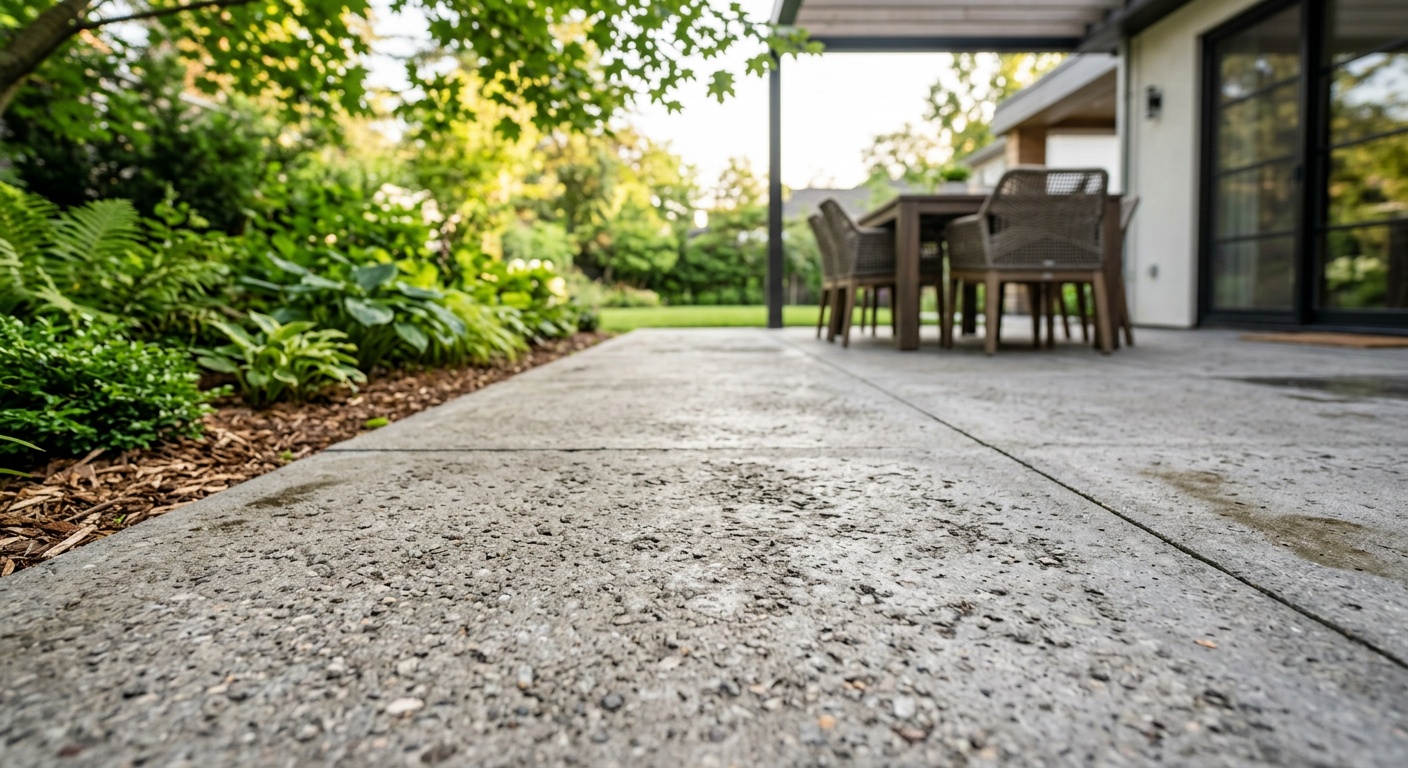
The surface layer is washed away before curing to reveal decorative stones and gravel embedded in the concrete. Creates a natural, textured appearance that hides stains well and provides excellent traction. Very popular in 2026 for its low-maintenance appeal.
Stamped Concrete
Additional cost: $5–$15 per square foot
Rubber stamps pressed into wet concrete mimic the look of stone, brick, slate, or wood. Single-pattern stamping is cheaper; multi-color, multi-pattern designs with saw-cut detailing sit at the premium end. This is the most requested upgrade in 2026, with the “travertine” and “ashlar slate” patterns dominating homeowner preference surveys.
Polished or Acid-Stained Concrete
Additional cost: $3–$8 per square foot
Acid stains penetrate the concrete to create a variegated, marble-like color effect unique to each pour. Polishing creates a reflective sheen more common indoors but increasingly used on covered outdoor patios. Both options require periodic resealing every 2–3 years.
Painted or Epoxy-Coated
Additional cost: $1.50–$4 per square foot
Budget-friendly way to add color. Concrete paint and epoxy coatings can refresh existing slabs or enhance new ones, but they require more frequent reapplication than staining or stamping.
DIY vs. Professional Installation: The Real Math
Every year, thousands of homeowners attempt DIY concrete patio pours inspired by YouTube tutorials. The honest truth? For patios larger than 100 square feet, DIY almost always costs more when you factor in mistakes, equipment rental, and time. Let’s look at the numbers honestly.
DIY Cost Estimate (300 sq ft patio):
- Ready-mix concrete delivery: $900–$1,400
- Gravel base material: $200–$400
- Rebar or wire mesh: $150–$300
- Form boards and stakes: $80–$150
- Tool rental (mixer, screed, float, edger): $200–$450
- Sealer and finishing products: $100–$200
- Total DIY estimate: $1,630–$2,900
Professional Installation (same 300 sq ft):
- All materials included
- Experienced crew labor
- Proper site prep and drainage
- Warranty on workmanship
- Total professional estimate: $3,600–$6,500
The gap looks compelling for DIY — until you consider what pros know that beginners don’t. Concrete curing is time-sensitive and unforgiving. One missed step in screeding, one wrong mix ratio, or one surprise rainstorm during the pour can result in a cracked, uneven slab that costs more to demolish and redo than the professional installation would have cost originally. According to a 2025 survey by the National Concrete Contractors Association, 38% of homeowners who attempted DIY concrete work reported needing professional remediation within two years.
Pro Tip: DIY makes financial sense only for very small pads (under 100 sq ft), if you have prior concrete experience, and if you can recruit at least two helpers. Otherwise, the professional investment pays for itself in quality and peace of mind.
Regional Cost Differences Across the U.S.
Your ZIP code matters enormously. Here’s a data visualization of average concrete patio installation costs per square foot across major U.S. regions in 2026:
Average Cost Per Square Foot by Region (2026)
These ranges reflect broom-finish basic pours. Decorative finishes add to every region’s baseline. The South and Southeast consistently offer the most competitive pricing due to lower labor costs and a dense contractor market. The Pacific Coast remains the most expensive region driven by strict environmental regulations, high permit costs, and premium labor rates.
Real Homeowner Examples: What Actual Projects Cost
Numbers in a table are one thing. Seeing how real projects play out gives you a far more grounded perspective on what to expect.
Case Study 1: The Budget-Conscious Midwest Homeowner
Marcus and Diane, homeowners in Columbus, Ohio, wanted a simple backyard patio to replace a deteriorating wooden deck. They chose a 320-square-foot rectangular broom-finish concrete slab with basic gray coloring. Their project timeline: Spring 2026.
- Site prep (deck demolition + grading): $850
- Concrete materials and pour: $1,920
- Labor (2-day installation): $1,600
- Sealing and finishing: $380
- Permit (Franklin County): $175
- Total: $4,925 (~$15.40/sq ft)
Their contractor advised against decorative finishes since they planned to add an outdoor rug and furniture that would cover most of the surface. Smart, functional thinking that saved them nearly $2,000 in unnecessary upgrades.
Case Study 2: The Premium Outdoor Living Investment
Jennifer and Carlos in Scottsdale, Arizona, were creating an outdoor entertainment area adjacent to their pool. They wanted 580 square feet of stamped concrete in a travertine pattern with integral tan coloring and a charcoal border detail.
- Site prep and grading: $1,200
- 6-inch reinforced concrete pour: $4,640
- Stamping, coloring, and detailing labor: $5,800
- High-performance sealer (UV-resistant for Arizona climate): $920
- Permits (Maricopa County): $320
- Total: $12,880 (~$22.20/sq ft)
Their contractor noted the UV-resistant sealer was non-negotiable in the Arizona desert climate. Skipping it would mean resealing annually instead of every three years — a $400/year maintenance cost that would eliminate the upfront savings within a few years.
Hidden Costs Nobody Warns You About
This section alone could save you thousands. Most contractor quotes include the visible costs, but these under-the-radar expenses catch homeowners off guard regularly.
Permits and Inspections
Depending on your municipality, patio permits range from $50 to $500+. Many homeowners skip permits to save money — and later discover they can’t sell their home without documentation of the improvement, or face fines requiring demolition of unpermitted work. Always pull the permit. It’s also worth knowing that in 2026, many cities have digitized permit processes that take 3–5 business days rather than the old 3-week wait.
Old Structure Removal
Demolishing and hauling away an existing concrete slab, wooden deck, or paver patio costs $500–$3,000 depending on size and material. This is almost never included in a new installation quote unless explicitly stated.
Drainage and Grading Issues
If your yard drains toward the house (a surprisingly common problem discovered during site prep), you may need French drains, regrading, or drainage channels. Budget $800–$2,500 for drainage remediation if your yard has existing water flow problems.
Utility Line Marking
Before any excavation, your contractor should call 811 (the national “Call Before You Dig” service) to mark underground utility lines. This is legally required in most states. Some contractors pass this cost to you; others absorb it. Confirm this is handled — hitting an unmarked gas line is a much bigger problem than a surprise invoice.
Sealing and Long-Term Maintenance
Quality concrete sealers run $150–$400 applied professionally every 2–5 years. Skipping sealing allows moisture penetration, freeze-thaw damage, and staining that significantly shortens your patio’s lifespan. Build this into your long-term ownership cost.
Frequently Asked Questions
How long does a concrete patio installation take from start to finish?
Most standard concrete patio projects take 2–4 days of active work, but the full timeline stretches longer. Site preparation typically takes one day. The pour itself can be completed in a single day for most residential projects. However, concrete requires a minimum of 24–48 hours before foot traffic and 28 days to reach full cure strength. Factor in scheduling and permit approval, and your total project timeline from first contractor call to using the patio is realistically 3–6 weeks in 2026’s busy construction market.
Is stamped concrete slippery, and is it worth the extra cost?
Stamped concrete can become slippery when wet if improperly sealed with a high-gloss sealer. However, most reputable contractors apply anti-slip additives to the sealer — a standard practice in 2026 — which dramatically improves traction. As for value: stamped concrete adds approximately 5–8% to home resale value according to 2025 Remodeling Magazine data, compared to 3–5% for basic concrete. If you plan to stay in your home long-term and use the patio heavily for entertaining, the aesthetic and value return typically justifies the investment over 7–10 years.
What’s the best time of year to install a concrete patio to get the best price?
Late fall and winter (October through February in most U.S. regions) are off-peak seasons for concrete contractors. You can typically negotiate 10–20% lower pricing during these periods when crews have less demand. The trade-off is that concrete should not be poured in temperatures below 40°F without cold-weather additives and protective measures, which add their own costs. In mild climates (Southeast, Southwest), winter installation is ideal. In cold-climate states, early spring before the summer rush offers the best balance of pricing and workable conditions.
Your Concrete Patio Action Plan: From Quote to Pour
You now have a comprehensive understanding of what drives concrete patio costs in 2026. Here’s how to turn that knowledge into a smart, strategic project plan:
Step 1: Define Your Must-Haves vs. Nice-to-Haves
Before calling a single contractor, write down your non-negotiables (size, primary purpose, drainage needs) and your wishlist items (decorative finish, built-in features). This prevents upselling from inflating your budget unpredictably.
Step 2: Get 3 Itemized Quotes
Never accept the first quote. Get at least three bids, and insist each contractor provides an itemized breakdown — materials, labor, site prep, and finishing as separate line items. Comparing lump-sum quotes is nearly meaningless. Comparing itemized quotes reveals who is padding which category.
Step 3: Verify Credentials and Insurance
In 2026, every legitimate concrete contractor should carry general liability insurance (minimum $1 million) and workers’ compensation coverage. Ask for certificates before signing anything. Check their license status through your state’s contractor licensing board — most now offer instant online verification.
Step 4: Understand the Contract’s Scope of Work
Your contract should explicitly state: square footage, concrete thickness, reinforcement type, finish specification, cure time before project completion, warranty terms, and payment schedule. If it doesn’t include these, request an amendment before signing.
Step 5: Budget a 15% Contingency
Site surprises happen. Hidden roots, unexpected drainage issues, and soil problems are common. A 15% contingency buffer prevents a surprise from derailing your project or your relationship with your contractor.
The broader trend is clear: outdoor living spaces have become a core component of home value strategy, not a luxury afterthought. In 2026, homebuyers increasingly evaluate outdoor entertainment space as a decisive factor — and a well-installed concrete patio consistently ranks among the top five outdoor improvements for ROI. The question isn’t just what your patio costs today — it’s what it contributes to your home’s livability and long-term market value for years ahead.
So here’s the real question to sit with: What would a beautifully finished, properly installed concrete patio actually be worth to your daily quality of life — and are you getting quotes that reflect that value, or just the cheapest number someone can put on paper? The difference between a good contractor and a great one often comes down to exactly that conversation.